








You don't have three competing labels. You have three different levels of problem.
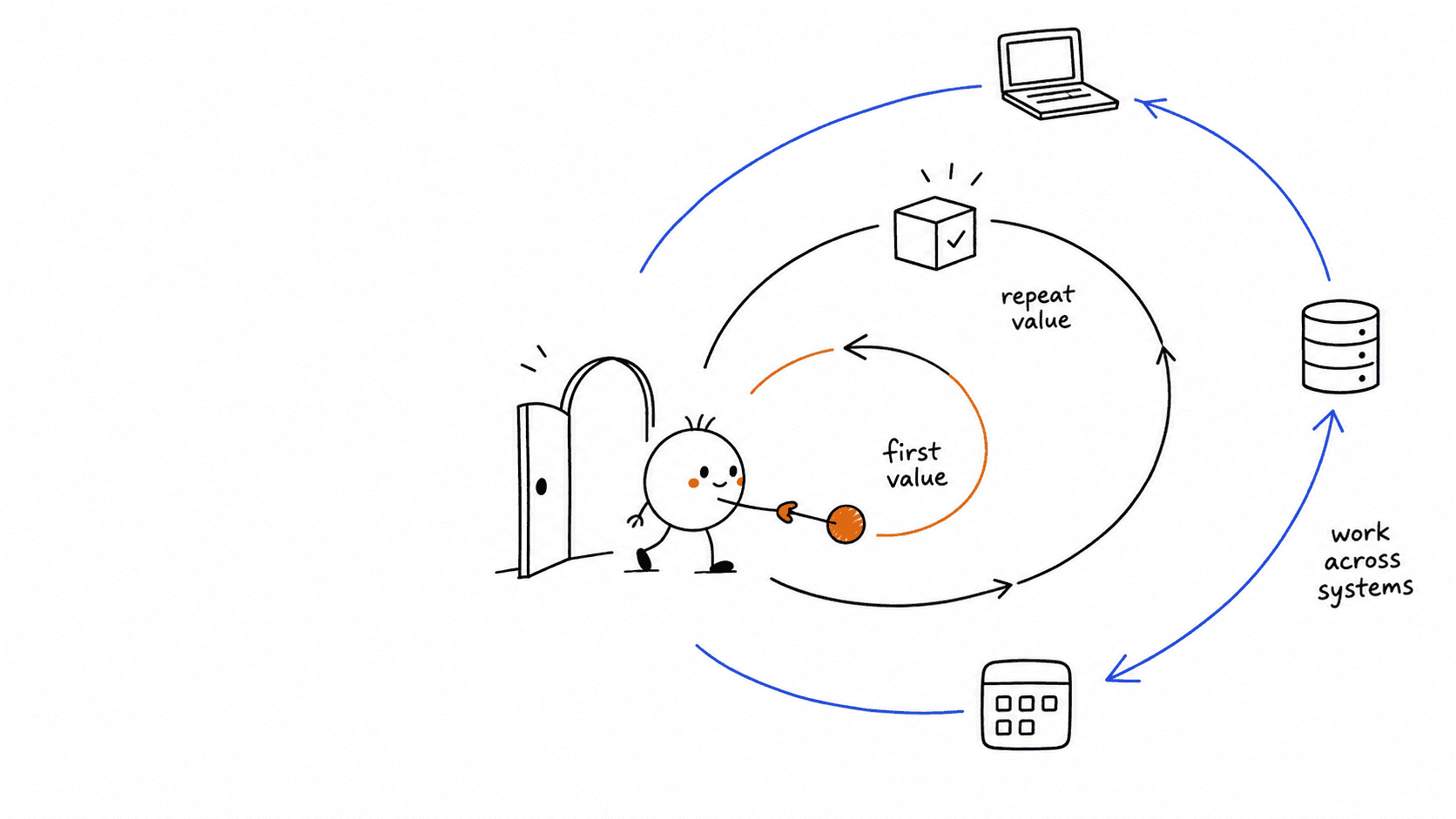
User onboarding helps someone new reach an initial useful outcome. Product adoption asks whether users or accounts keep getting value from the product. Digital adoption asks whether people can complete critical work through the digital systems an organization provides.
That distinction changes what you measure, who should own the work, and what software belongs on the shortlist. Buy a digital adoption platform for a first-session problem and you may overbuild. Buy a tour builder for a cross-system transformation and you may solve only the most visible symptom.
The short answer
- User onboarding is an enabling process: help a new user, role, or feature user reach first value and work with reasonable independence.
- Product adoption is a product-level outcome: intended users or accounts repeatedly complete value-bearing workflows at the cadence their job requires.
- Digital adoption is a broader organizational outcome: intended users can execute critical work effectively through one or more digital systems.
The buying rule is simple: diagnose the scope and outcome before choosing the category. Onboarding can improve product adoption. Product adoption can sit inside a wider digital adoption program. None of them is proved by a completed tour.
Compare the problem before you compare the software
This table is meant to identify which problem is actually failing, not force every initiative into one box.
| Decision | User onboarding | Product adoption | Digital adoption |
|---|---|---|---|
| Core question | Can a new user reach first value independently? | Are intended users or accounts getting recurring value? | Can people execute critical work through the required systems? |
| Scope | One product, role, or new capability | One product across its customer lifecycle | One or more systems, often across a business process |
| Typical moment | New user, new role, or new feature | Activation through retained and expanded use | Rollout, go-live, and ongoing process or system change |
| Common owner | Product, growth, design, CS, implementation | Product, growth, CS, data, product marketing | IT, application and process owners, operations, L&D, change leaders |
| Primary measures | First-value time, activation, task success, drop-off | Qualified use, breadth, depth, frequency, retention | Task completion, time, errors, proficiency, support demand |
| Typical tooling | Product UX, analytics, onboarding or implementation tools | Product analytics, messaging, guidance, feedback, CS workflows | DAP, analytics, training, change, knowledge, support, process redesign |
| Common mistake | Measuring content completion instead of value | Counting logins instead of successful workflows | Counting deployed licenses or guide views instead of correct work |
The key difference is the unit of success. Onboarding looks at a transition. Product adoption looks at recurring product value. Digital adoption looks at work performed through a digital environment.
What does product adoption actually measure?
For B2B SaaS teams, product adoption means sustained use of the workflows that create customer value. It is wider than onboarding and more demanding than activity.
There is genuine disagreement about the boundary. Information-systems research often separates adoption, meaning first use, from continuance after first use. Current product-analytics practice uses product adoption more broadly for discovery, value realization, and integration into ongoing behavior. For this guide, the second meaning is more useful: call the first meaningful success activation, then ask whether valuable use continues. The research distinction between adoption and continuance and Mixpanel's current product-adoption definition make that disagreement visible.
Imagine a collaboration product. New accounts create a project and return the following week, but few invite teammates or run the approval workflow that makes the product valuable at scale. Onboarding may have worked. Adoption has plateaued.
Measure that problem with signals tied to the customer's job:
- Qualified use: did the user complete a workflow that produces value, not merely open a page?
- Breadth: how many eligible people in an account use the product?
- Depth: which validated core workflows do they use?
- Frequency: do they return at the cadence the job requires?
- Retention or expansion by behavior: do accounts with those patterns stay or grow more often?
Pendo's breadth, depth, and frequency framework is a useful starting structure, but its thresholds must come from your own history and customer outcomes. Amplitude likewise recommends defining a critical event and natural usage interval. A monthly reporting tool should not imitate the activity target of a daily collaboration app.
Product adoption also does not mean using every feature. A customer can be fully adopted with a narrow workflow if that workflow delivers the promised value. Pushing unused features without understanding relevance can create noise instead of value.
What should user onboarding accomplish?
User onboarding should make a novice capable, not make a walkthrough reach 100% completion.
A practical definition is: the product, guidance, support, and communication that helps someone new to a product, role, or capability reach an initial useful outcome and operate with reasonable independence. HCI research describes onboarding as helping users discover relevant functionality in time and connect it to their goals. The same research warns that guidance does not replace usable product design. The 2021 DIS study is especially useful on that tradeoff.
Suppose a B2B analytics product gets plenty of trial signups. Most users stall while connecting a data source and never save a useful report. That is primarily an onboarding problem.
The team should measure:
- time from signup to the first useful report
- conversion through the required setup steps
- successful completion of the first real task
- help or human intervention required
- return behavior after first value
The intervention might be a better integration flow, a sample dataset, a starter template, a shorter checklist, contextual help, or an implementation call for complex accounts. A product tour is only one option. If the setup itself is confusing, another tooltip can hide the flaw without removing it.
Onboarding also does not need an arbitrary seven-day endpoint. It ends for a particular job when the user can get value with reasonable independence. An existing customer can therefore need feature onboarding when a new capability makes them a novice again.
Some practitioners use onboarding even more broadly. Intercom, for example, has argued that onboarding continues as customers encounter relevant features throughout their lifecycle. That framing is useful until it makes every message “onboarding.” A cleaner boundary is to reserve onboarding for a transition into competence, then use adoption to judge what happens afterward. Intercom's setup, activation, utilization, and maturity model shows how one SaaS company separates those milestones in practice.
Why is digital adoption broader?
Digital adoption is the most overloaded term of the three.
Policy sources use it to discuss whether companies have taken up digital technologies. Eurostat's Digital Intensity Index, for example, classifies enterprises by how many of 12 selected technologies they use. That is a valid macro measure, but it does not tell an operations leader whether employees can complete a quote correctly in a new CRM. Eurostat documents both the measure and its changing survey composition.
The software market uses the term differently. Gartner defines a digital adoption platform, or DAP, as software that overlays employee- and customer-facing applications with in-application guidance to improve proficiency, engagement, and efficient work across applications. That current category definition is broader than a customer-facing product tour tool and is not limited to employees.
For a practical B2B decision, define digital adoption as the ability of intended users to complete critical work effectively through the digital systems provided to them. A digital adoption program is the operating discipline around that outcome. A DAP is one possible tool.
Consider a manufacturer rolling out a quote-to-cash process across CRM, pricing, and ERP systems. Employees completed training, but production errors, rework, and tickets remain high. This is a digital adoption problem because the failing unit is a cross-system business workflow.
The useful measures are closer to task performance than marketing engagement:
- successful task or process completion
- time on task and time to proficiency
- error, exception, or rework rate
- process adherence where it matters
- support tickets per eligible or active user
- the downstream business result, such as quote cycle time
These measures are not invented by the DAP category. NIST's usability guidance uses task completion, time, errors, and satisfaction to evaluate whether people can use a system effectively. Its measurement handbook offers a defensible baseline. Current DAP guidance adds production signals such as proficiency, ticket demand, exceptions, and adherence; Whatfix's current operating model is a vendor view, so its commercial claims should be treated separately from the measurement logic.
A DAP can place support inside the workflow and reveal where people struggle. It cannot make a broken approval policy sensible or repair an application defect. Training, change management, process redesign, application work, and support still matter.
How do the three overlap without becoming synonyms?
The cleanest model is intervention, product outcome, organizational scope:
- Onboarding is an intervention around a transition. It helps a novice reach competence and first value.
- Product adoption is the product outcome. It asks whether meaningful use continues and expands where useful.
- Digital adoption changes the scope. It asks whether people can perform critical work across the digital environment.
Take a new approvals feature in a SaaS product. A targeted announcement, checklist, contextual guide, help article, and success call are feature-onboarding interventions. Success becomes product adoption only when eligible accounts use approvals correctly at the expected cadence.
Now put the same approval step inside a quote-to-cash process spanning three enterprise systems. The user may still need onboarding, but the program is a digital adoption initiative because ownership, risk, measurement, and tooling extend beyond one product.
This is why the labels sometimes appear interchangeable on vendor websites. The same UI patterns can support all three. The purpose and scope determine the category, not the presence of a tooltip.
Which problem do you have, and what should you buy?
Use this framework before you create a software shortlist.
| What you observe | Primary diagnosis | Measure first | Appropriate tooling class |
|---|---|---|---|
| New users stall before a first useful outcome | User onboarding | First-value time, setup conversion, first-task success | Product analytics plus UX fixes, onboarding tools, help, or human implementation |
| Activated users return but avoid important workflows | Product adoption | Qualified use, breadth, depth, natural-cadence frequency | Product analytics plus product changes, messaging, guidance, feedback, and CS workflows |
| People fail a process across several enterprise systems | Digital adoption | Task success, time, errors, proficiency, tickets, business KPI | DAP plus process/application work, training, change, knowledge, and support |
The table is a starting diagnosis. Ask four follow-up questions before buying:
- Who is failing? A new individual, an activated customer account, or a workforce cohort?
- What job is failing? First setup, recurring product value, or a business process?
- Where does the work happen? One product you control, or several systems owned by different teams?
- What evidence would prove improvement? A first outcome, retained qualified use, or better task performance?
If the answer is “one high-touch customer implementation,” you may need customer-onboarding project software rather than a tour builder or enterprise DAP. If the answer is “we do not know which behaviors predict retention,” start with instrumentation and research. Guidance software cannot compensate for a missing definition of value.
Where does Userorbit fit?
Userorbit is relevant when the problem is customer-facing SaaS onboarding and product adoption, especially when guidance must connect with the work that follows.
Userorbit Onboard supports product tours and checklists. Its Help Center documents property-based tour targeting, property-based checklist targeting, and interaction or completion reporting for tours and checklists. Those signals help teams improve onboarding, but they should still be connected to activation and qualified product use.
The broader fit is a connected workflow: onboarding can sit beside announcements, feedback, surveys, help content, roadmap communication, and product analytics. That can suit a lean product, growth, or customer-success team that does not want adoption work split across several point tools.
Userorbit is not the default recommendation for workforce transformation across ERP, CRM, desktop, VDI, and regulated cross-application processes. That buying job deserves an enterprise DAP, training and change capabilities, and the necessary process or application work. For a current view of where onboarding platforms and enterprise DAPs diverge in packaging and fit, use the 2026 onboarding software pricing comparison.
Put the metric before the category label
You can avoid most category mistakes with four steps:
- Name the actor and the job. “New workspace admins must publish their first report” is better than “improve adoption.”
- Define the success event and interval. State what valuable completion looks like and when it should recur.
- Measure the current failure. Find the broken step, cohort, workflow, error, or behavior before choosing an intervention.
- Match the tool to the scope. Fix the product when you own the friction. Add onboarding when a novice needs help. Add adoption workflows when valuable use stalls. Evaluate a DAP when the problem spans systems and organizational change.
The labels are useful only when they sharpen a decision. Start with the work users must accomplish, then choose the smallest system that can improve it and prove the outcome.
Frequently asked questions
Short answers to common questions about onboarding, product adoption, and digital adoption.