








Most roadmap problems are audience problems in disguise.
Engineering needs delivery detail. Leadership needs investment choices and outcomes. Customers need a trustworthy sense of direction. When one timeline tries to serve all three, it becomes either vague enough to be useless or precise enough to create promises the team cannot keep.
Jira Product Discovery is the best starting point for SaaS teams already using Jira. Productboard is stronger when customer evidence and formal product planning need one system. Userorbit is the better choice for a customer-facing roadmap that should connect directly with feedback and release communication. The rest of this guide separates those jobs so you can choose a tool that matches the roadmap you actually need to operate.
The shortlist by roadmap job
| Tool | Best for | Starting point | Main tradeoff |
|---|---|---|---|
| Jira Product Discovery | SaaS product teams already using Jira and Confluence | Free for three creators; Standard $10/creator/month | Cloud only and centered on Atlassian workflows |
| Productboard | Evidence-led, multi-team product organizations | Free; Plus from $19/maker/month annually | Requires more taxonomy and product operations |
| Userorbit | Customer-facing roadmaps connected to feedback and releases | $95/month billed annually | Lighter internal portfolio and capacity planning |
| Aha! Roadmaps | Deep strategy, planning, dependencies, and reporting | $59/user/month billed annually | Heavy for a simple customer roadmap |
| airfocus | Portfolio governance across several product teams | Custom quote | No public dollar price |
| Canny | A public roadmap driven by feedback requests | Free; Pro from $79/month billed annually | Lighter strategic and portfolio planning |
| ProductPlan | Polished leadership and stakeholder communication | Custom quote | Less customer-feedback depth and no public price |
Roadmap software is not delivery software
A product roadmap explains why the team is investing and which outcomes, problems, or capabilities are likely next. A release plan coordinates committed scope, dependencies, and timing. A backlog stores possible and committed delivery work.
Many platforms cover more than one layer, but one layer should remain authoritative. Jira Product Discovery stays close to engineering delivery. Productboard, Aha!, and airfocus add more strategy and product hierarchy. Userorbit and Canny focus on the public customer loop. ProductPlan emphasizes a clear view for internal stakeholders.
We compared the tools across roadmap audiences, evidence connections, prioritization, delivery integrations, communication, portfolio controls, and pricing. Userorbit publishes this guide and has deeper first-hand access to its own workflow. Competitor facts were checked against official product and pricing pages; the recommendations reflect fit, not a claim that we migrated the same live portfolio into every platform.
Before buying anything, decide whether exact dates belong in the roadmap. Now-next-later views communicate direction without false precision. Timelines are better for dependencies and committed launches. Strong products can expose different views over the same underlying decisions without forcing customers, executives, and delivery teams into one level of detail.
1. Jira Product Discovery: best for teams already using Jira
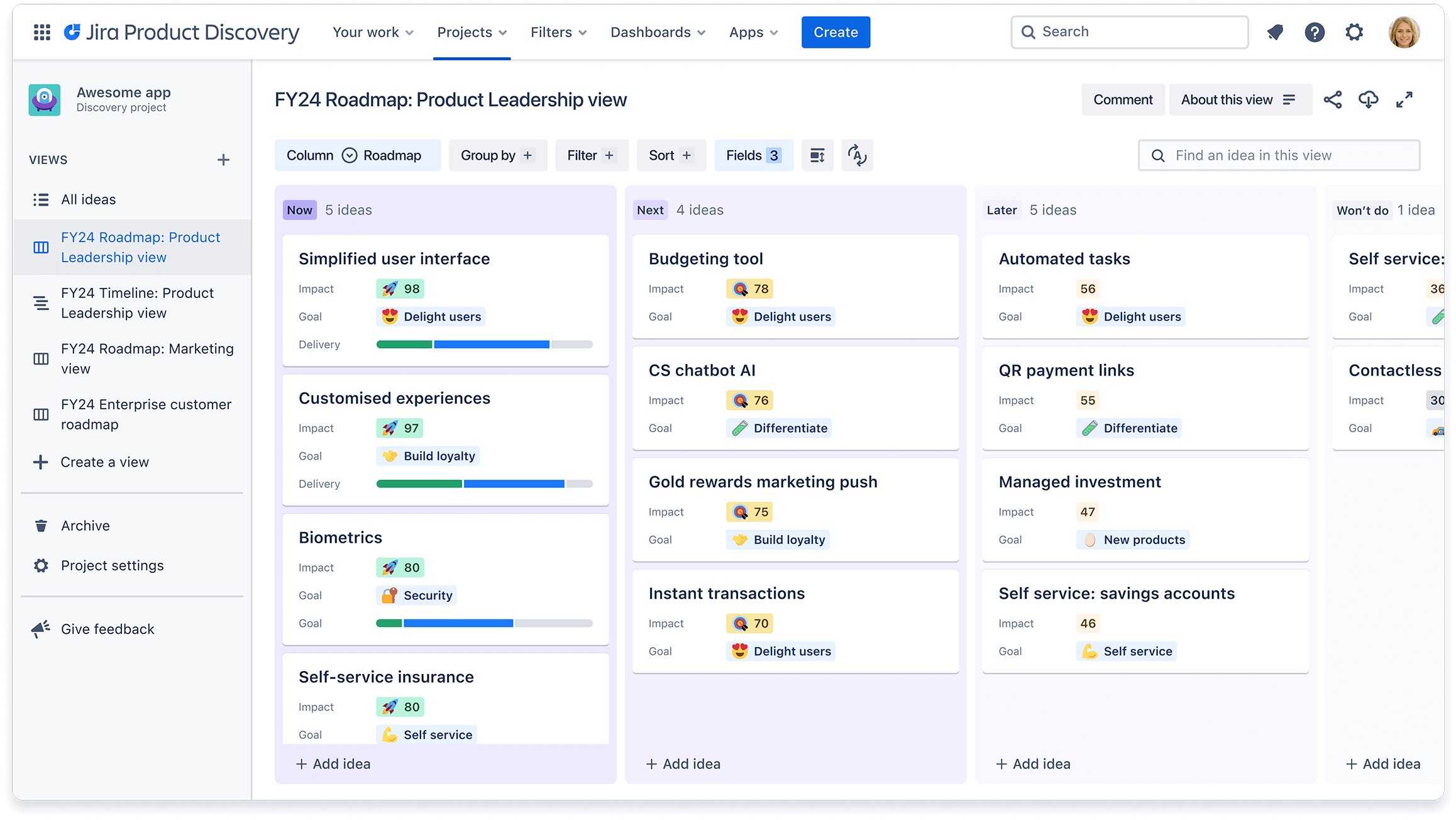
Image source: Atlassian's Jira Product Discovery roadmaps page.
What this does
Jira Product Discovery gives product teams a place to capture ideas and insights, compare them with custom fields and formulas, publish board or timeline views, and connect selected ideas with Jira delivery work. Contributors can comment, vote, react, and add context without becoming paid creators.
The free plan supports three creators. Standard costs $10 per creator per month, and Premium costs $25 per creator per month with larger-scale roadmap and governance capabilities. Contributors remain free.
Strengths
The native discovery-to-delivery connection is its clearest advantage. When engineering work already lives in Jira and supporting documents live in Confluence, product reasoning can stay close to execution instead of becoming another system that someone has to reconcile by hand.
Its flexible fields, formulas, board views, and timelines also let a team create different presentations for product, leadership, and delivery without copying the underlying ideas into separate decks.
Best for
SaaS product teams already committed to Jira and Confluence, especially those whose biggest roadmap risk is product reasoning drifting away from engineering delivery.
Not best for
Teams looking for a standalone public feedback portal and customer release loop. Jira Product Discovery is cloud only and naturally assumes an Atlassian-centered operating model, so a customer-facing roadmap may still require another product.
2. Productboard: best for evidence-led product organizations
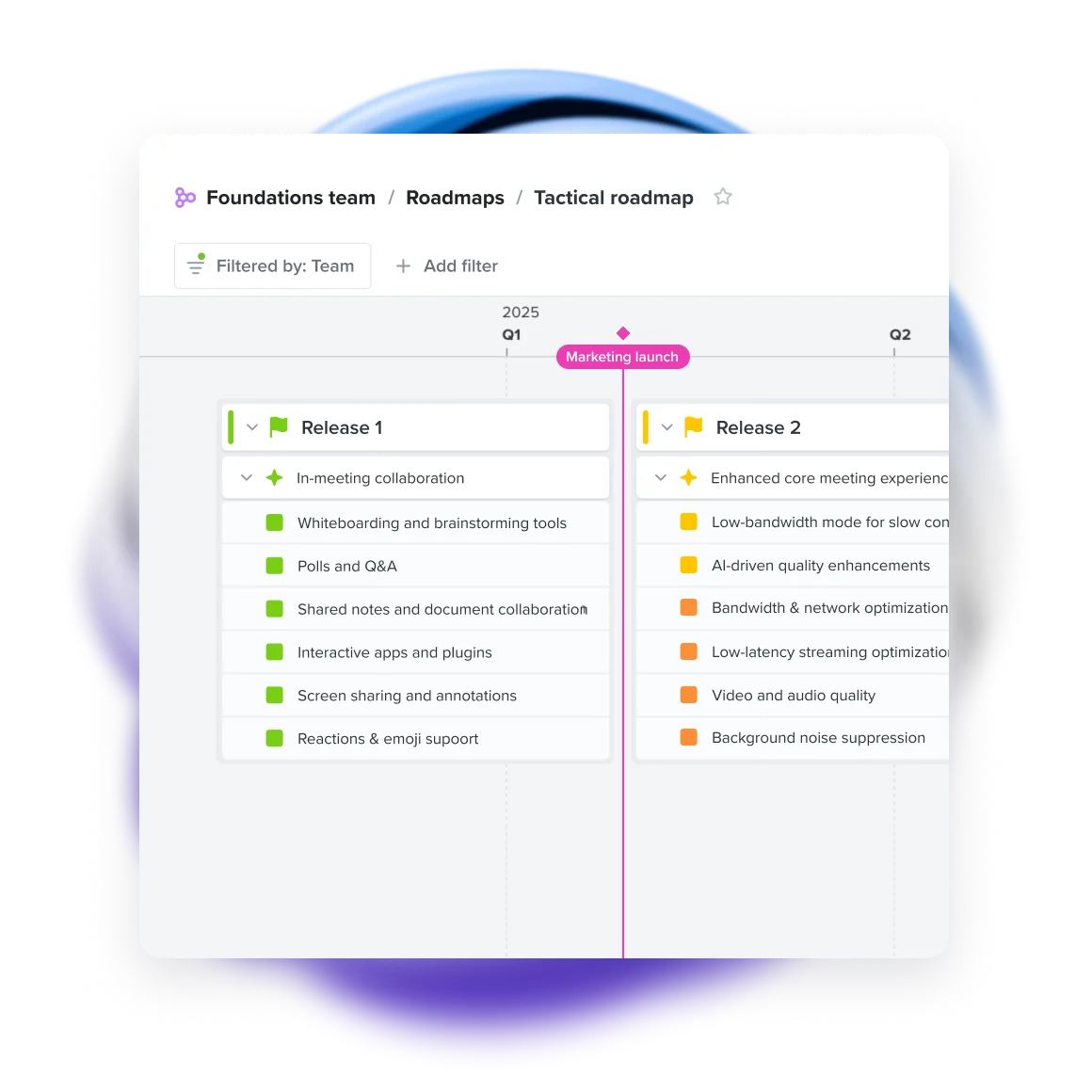
Image source: Productboard's product roadmapping page.
What this does
Productboard connects a customer-insight repository with ideas, product hierarchy, segmentation, prioritization, roadmaps, portals, and release planning. It is designed to let a team trace a roadmap decision back to customer evidence rather than maintain separate research and planning artifacts.
The free plan includes unlimited roadmaps, prioritization, up to 500 feedback notes, and one portal. Plus costs $19 per maker per month billed annually. Business costs $59 per maker per month with a two-maker minimum and expands the feedback, teamspace, and portal controls.
Strengths
Productboard is strongest when a roadmap is only one view of a larger product-management system. Makers can work from a shared hierarchy and evidence base while leadership, delivery teams, and customers receive different roadmap views. That makes it easier to explain not only what is planned, but why it earned priority.
Best for
Multi-team product organizations with a product-operations practice, formal product taxonomy, and a need to connect customer insights with prioritization and planning.
Not best for
Small teams that mainly need a simple public now-next-later page. Productboard only becomes trustworthy when someone consistently maintains its notes, hierarchy, segments, and roadmap structure, so the operational cost can exceed what the subscription price suggests.
3. Userorbit: best customer-facing roadmap for lean B2B SaaS
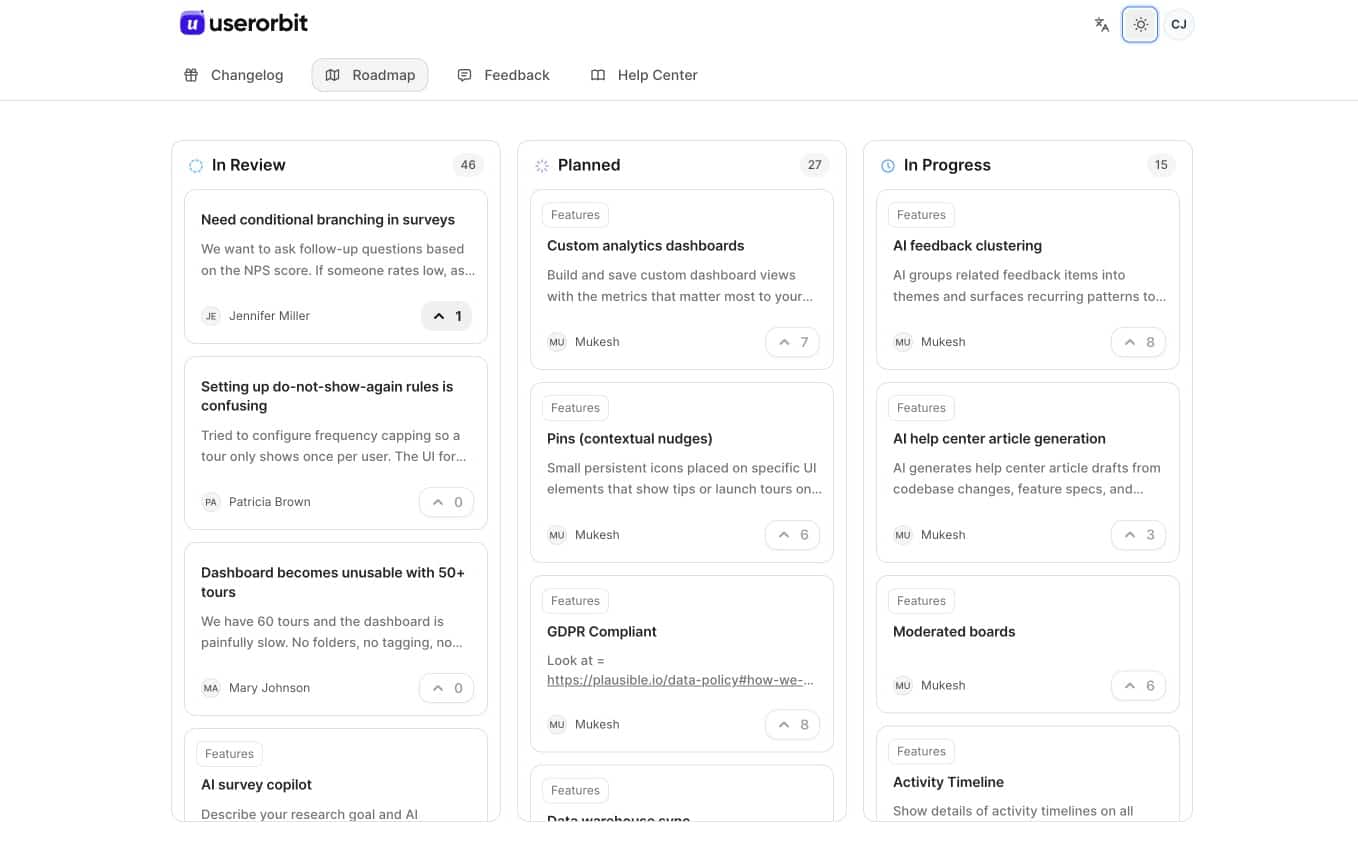
Image source: Userorbit's product roadmap page.
What this does
Userorbit's product roadmap stays in the same workspace as feedback boards, surveys, announcements, onboarding, support context, and adoption analytics. A product team can preserve the evidence behind an item, publish only the direction customers should see, and then communicate what shipped without losing the original thread.
Growth costs $95 per month billed annually for 5,000 MAUs and includes the public roadmap, feedback boards, announcements, branding, integrations, and unlimited team members.
Strengths
The roadmap is part of a connected customer loop rather than a separate planning artifact. Feedback can inform a decision, the public roadmap can communicate its status, and an announcement can close the loop when the work ships. The bundled pricing is also easier for a lean team to predict than paying for several connected point products or per-seat planning tools.
Best for
Lean B2B SaaS product and customer teams whose roadmap is primarily a customer communication surface and who want feedback, priorities, releases, and adoption work in one system.
Not best for
Large organizations that need portfolio finance, resource-capacity planning, or detailed cross-product dependency management. Those teams may use a deeper internal planning layer and reserve Userorbit for the customer-facing loop.
4. Aha! Roadmaps: best for deep strategy and product planning
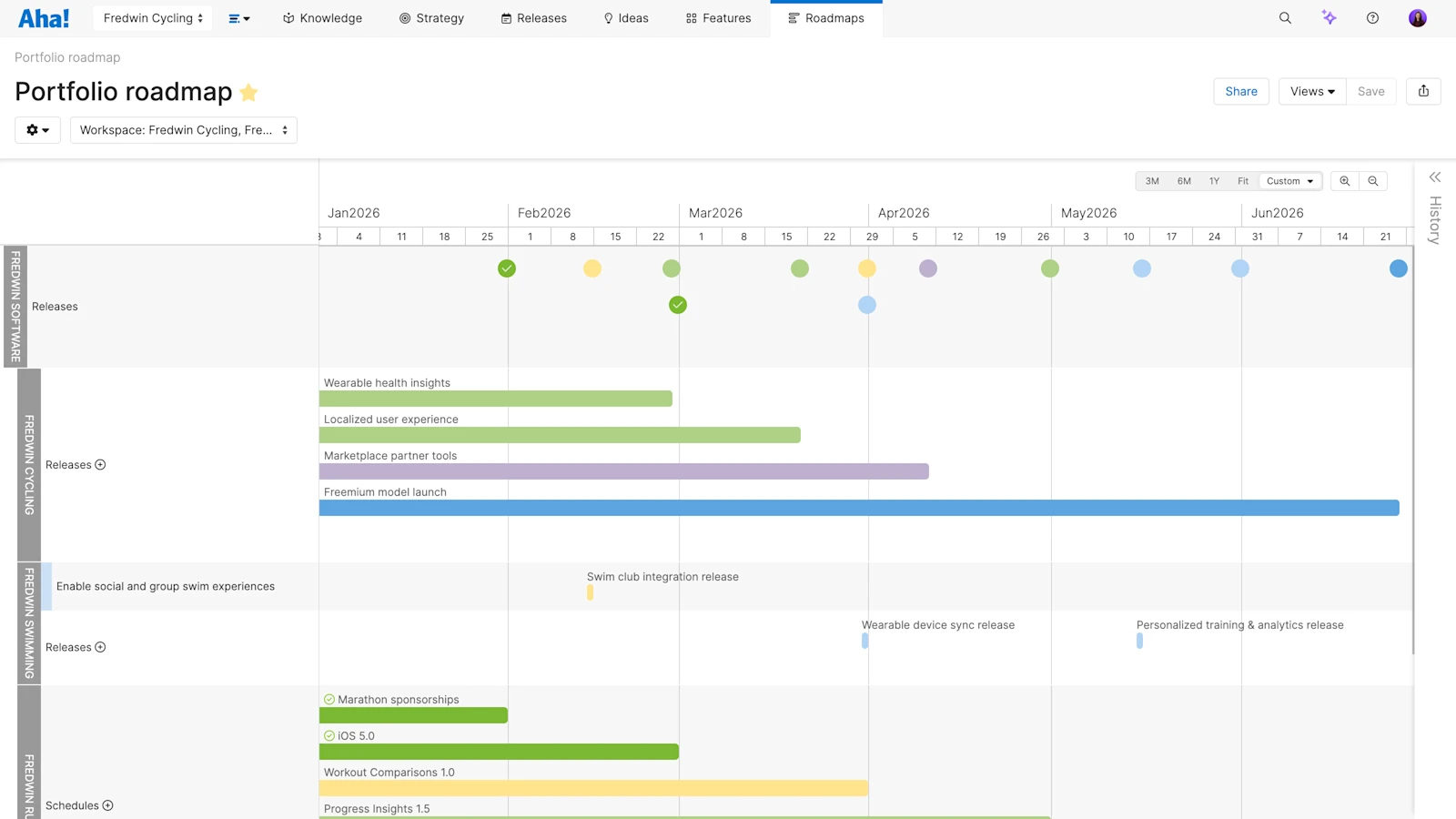
Image source: Aha! Roadmaps' visual roadmaps page.
What this does
Aha! Roadmaps has the most structured product-management model in this comparison. It connects strategy, objectives, ideas, prioritization, releases, dependencies, reports, presentations, workflows, and delivery integrations.
Premium starts at $59 per user per month billed annually, while Enterprise starts at $99 per user per month and changes the reviewer and viewer model. Active planning seats and optional products should be included in the budget.
Strengths
Aha! can trace company goals through initiatives, product plans, and release work. Its broad library of roadmap types and reporting options can replace a patchwork of planning spreadsheets, leadership decks, and disconnected databases. The portfolio view is especially useful when several product lines must show how their releases support shared strategic initiatives.
Best for
Mature product organizations with formal strategy-to-execution processes, complex dependencies, multiple products, and leadership reporting requirements that justify a structured planning system.
Not best for
Lean SaaS teams that only need a simple internal or public roadmap. Aha! asks for significant configuration and administration, and its per-user pricing becomes harder to justify when most of the strategy and portfolio surface would go unused.
5. airfocus: best for portfolio intelligence and governance
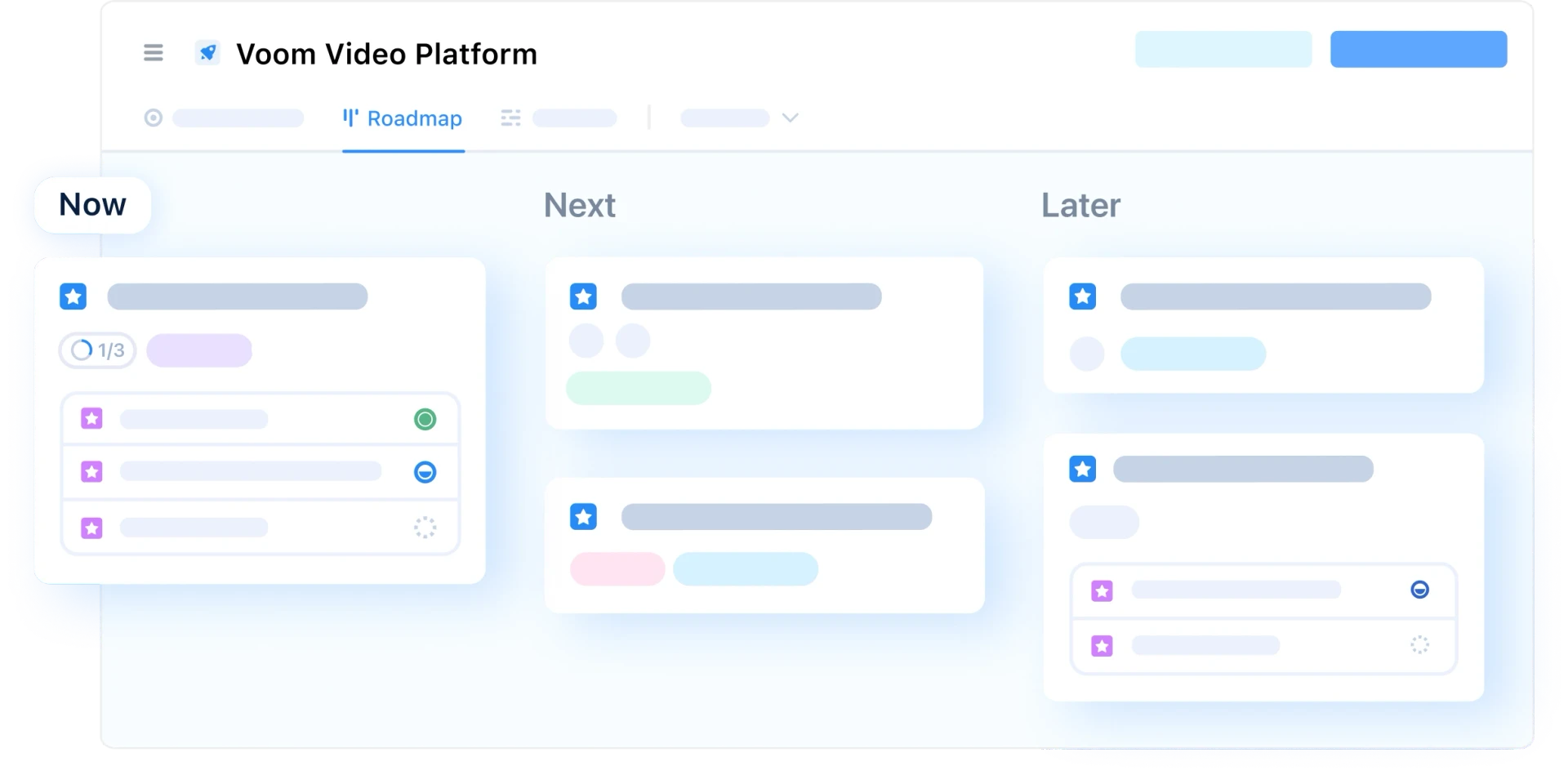
Image source: airfocus's product roadmaps page.
What this does
airfocus is built for product operations across several teams. It offers flexible roadmap views, hierarchy, prioritization, feedback and insights, objectives, branded portals, portfolio dashboards, and capacity planning as teams move up the plan structure.
The pricing page describes Professional and Enterprise capabilities but requires a quote. Professional includes unlimited workspaces and contributors, multiple views, feedback, insights, hierarchy, and branded portals; Enterprise adds deeper objectives, portfolio, capacity, and governance.
Strengths
airfocus combines adaptability with governance. Autonomous teams can operate their own workspaces and choose useful roadmap views, while product leaders roll that information into a more consistent portfolio picture. It is flexible enough to model different team processes without giving up the cross-team visibility product operations needs.
Best for
Product-operations teams governing several product teams, especially when each team needs local flexibility but leadership still needs shared prioritization, hierarchy, and portfolio reporting.
Not best for
Small teams publishing one straightforward customer roadmap. They may not use the portfolio surface, and the lack of a public dollar price makes early budget comparison less efficient.
6. Canny: best for a feedback-driven public roadmap
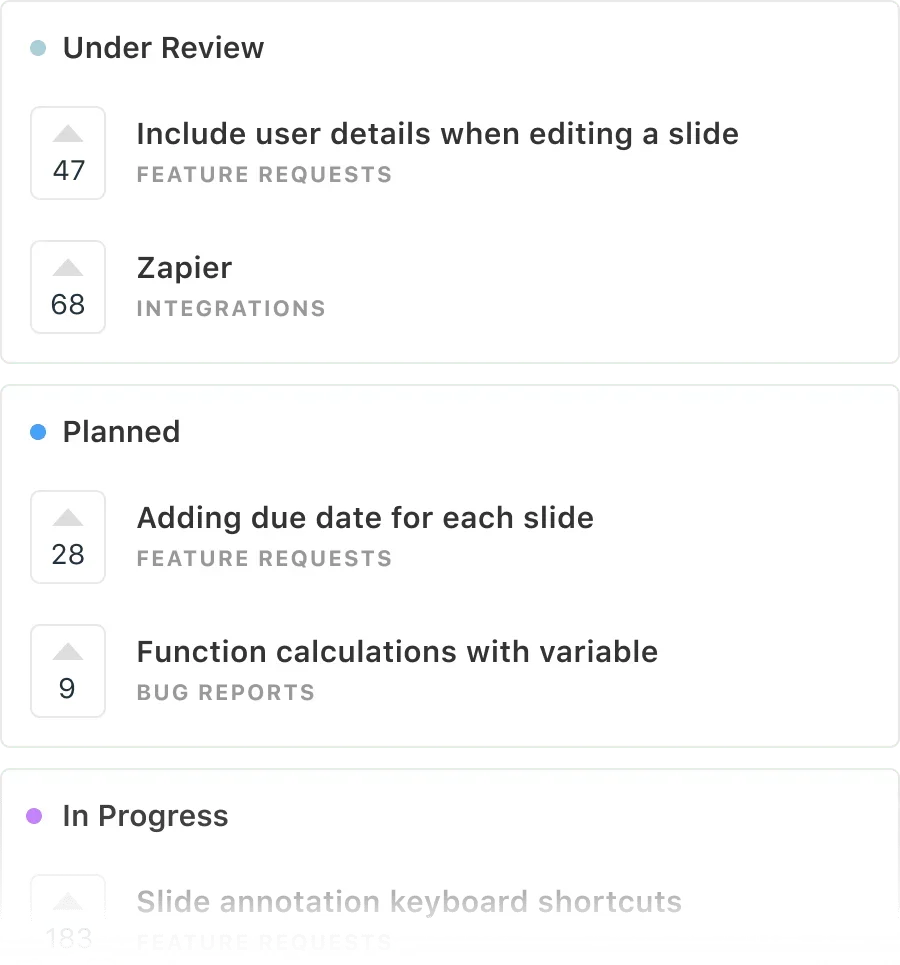
Image source: Canny's public roadmap page.
What this does
Canny makes the roadmap the visible next stage of a request workflow. Customers submit and vote on feedback, teams merge and segment the evidence, selected items receive public statuses, and the changelog communicates shipped work.
Canny has a free plan for 25 tracked users, and Pro starts at $79 per month billed annually. The tracked-user definition includes people attached to submitted, voted, commented, administrator-added, or automatically captured feedback, so participation affects the bill. See the full Canny pricing bands and scenario math before forecasting a larger portal.
Strengths
The public roadmap model is easy for customers to understand and lighter to operate than a complete product-management suite. Integrations with Jira, Linear, Asana, GitHub, Azure DevOps, and other delivery products let execution remain in the team's existing system while Canny manages the customer-facing request and status loop.
Best for
Teams that want a focused public feedback board to flow directly into a customer roadmap and changelog, while keeping detailed product planning and delivery somewhere else.
Not best for
Organizations seeking deep strategic hierarchy, portfolio governance, or capacity planning. Participation also affects the tracked-user bill, so teams with broad customer engagement should model likely usage before choosing a paid plan.
7. ProductPlan: best for stakeholder-ready roadmap communication
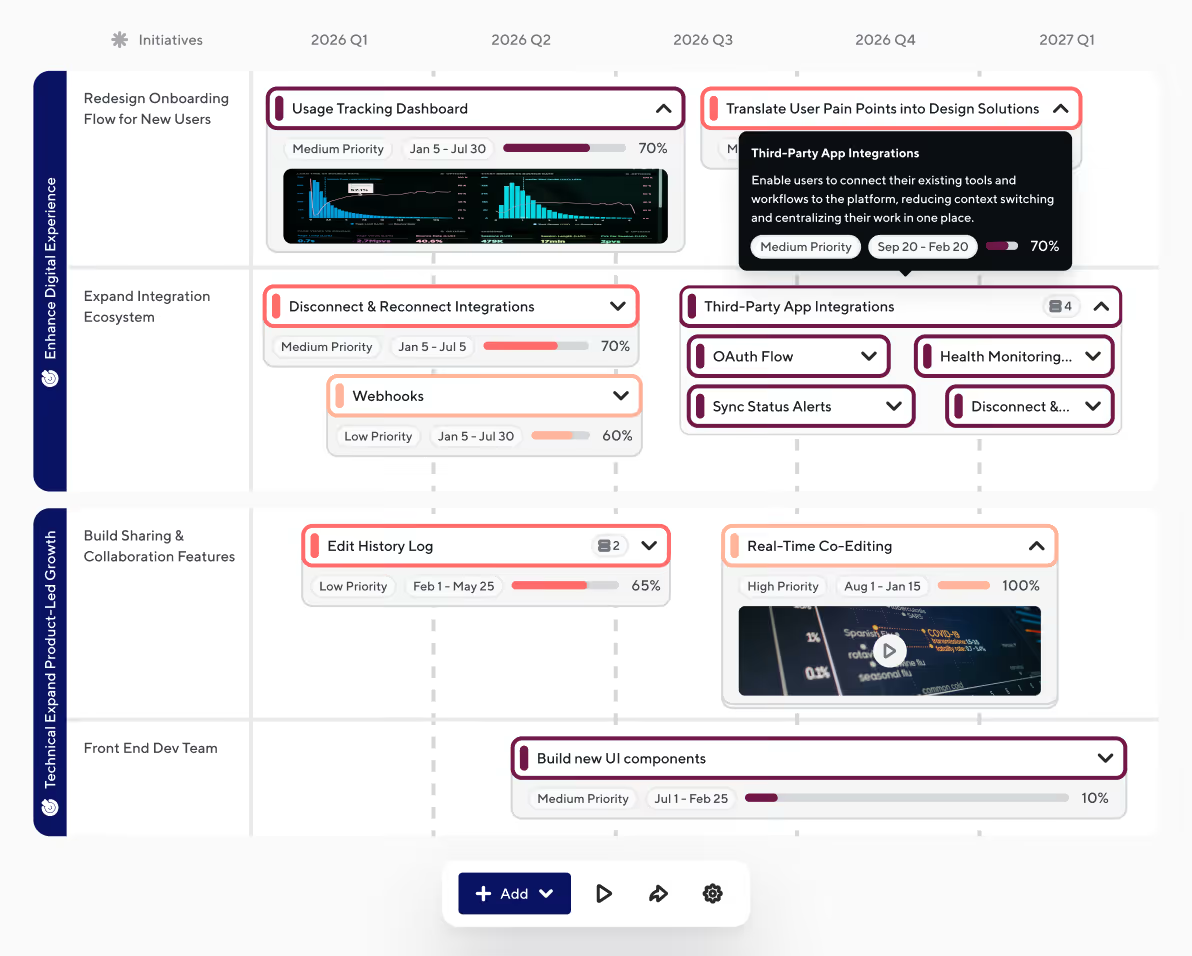
Image source: ProductPlan's product roadmaps page.
What this does
ProductPlan focuses on making product plans clear to leadership and cross-functional stakeholders. It supports unlimited roadmaps and viewers, portfolio views, objectives, dependencies, prioritization, launch management, product research, and integrations.
ProductPlan pricing is quote-based through one Product Intelligence Platform plan, so buyers cannot make a complete budget comparison from the public page.
Strengths
Its visual roadmap views are built for communication. Unlimited viewers reduce the access friction that often pushes plans back into exported slide decks, while portfolio and objective views help leaders understand how work fits together. ProductPlan is strongest when an organization wants an always-current planning surface that remains polished enough for stakeholder reviews.
Best for
Product teams whose roadmap's central job is clear, polished alignment across leadership and internal stakeholders, particularly when many viewers need access without consuming paid planning seats.
Not best for
Teams prioritizing a public feedback portal and in-app customer communication. ProductPlan is less centered on that loop than Canny or Userorbit, and quote-based pricing makes it harder to compare during an early shortlist.
Match the tool to the authoritative audience
- Product and engineering already operate in Jira: start with Jira Product Discovery.
- Customer evidence and formal planning need one governed system: shortlist Productboard.
- The roadmap is primarily for customers and should connect with feedback and announcements: compare Userorbit with Canny.
- Strategy, dependencies, releases, and reporting need a deep data model: evaluate Aha! Roadmaps.
- Product operations governs several team roadmaps and a portfolio: look at airfocus.
- Leadership communication is the primary deliverable: consider ProductPlan.
Test the decision loop, not the roadmap screenshot
During a trial, create one opportunity supported by conflicting customer evidence. Ask the product to preserve the source records, show the opportunity differently to customers and executives, connect it to delivery work, change its priority, and record why the decision changed.
Then complete the customer-facing half of the test. Publish a safe status update, prepare the release communication, and decide how the team would check whether the intended users discovered or adopted the result. The roadmap does not need to perform every job itself, but it should preserve enough context for those handoffs to remain credible.
If AI is part of the workflow, require it to prepare evidence and counterevidence rather than silently change priority. The AI roadmap prioritization guide includes a reusable weekly decision packet and approval boundary.
A roadmap product should make these transitions safer. A pretty timeline alone is not enough.
Sources and update notes
This comparison focuses on dedicated product-roadmapping and connected product-management systems. Generic project-management boards and presentation software were excluded because they do not preserve product evidence and prioritization context by default. Capabilities, public prices, and plan boundaries were rechecked against official vendor pages on August 30, 2026.
Frequently asked questions about product roadmap software
Practical answers for SaaS teams choosing a roadmap and planning platform.