









Your launch goes well. Seventy-six customers vote on the same feature request. Nobody on the product team needs another seat, but the Canny account has outgrown Free and now costs at least $948 for a year of Pro.
Add 25 more voters and the price moves again. The 101st tracked user takes Pro from $79 to $129 a month on annual billing.
That is the useful way to read Canny pricing. The meter follows customers attached to feedback, not the number of people managing it. As of August 25, 2026, Canny offers Free, Pro, and a custom-priced Business plan.
Canny is competitively priced when you want a focused feedback system and the tracked-user count stays modest. A busy public board or broad automatic capture can make the bill climb while the size of your team stays exactly the same.
How much Canny costs in 2026
The current Canny pricing page has three plans for new customers.
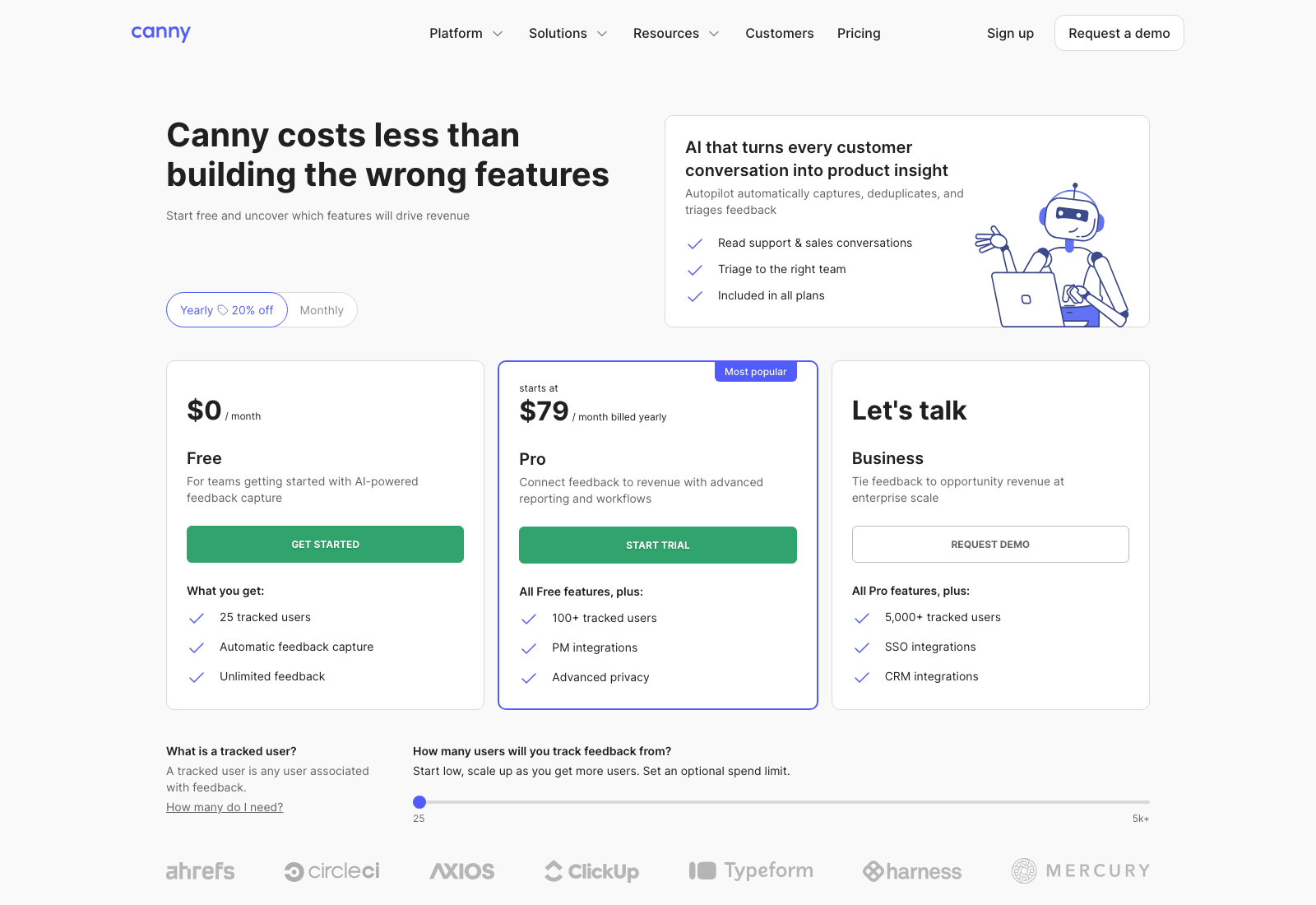
Canny's public pricing page, captured August 25, 2026.
| Plan | Public price | The practical limit |
|---|---|---|
| Free | $0 | The account can have only 25 tracked users |
| Pro | From $79/month billed annually or $99 month to month | Price increases through tracked-user bands from 100 to 5,000 |
| Business | Custom quote | Canny positions it for roughly 5,000+ tracked users and enterprise requirements |
The annual Pro price is a monthly equivalent. At the entry band, Canny charges $948 upfront for the year. Paying month to month costs $99, or $1,188 across 12 months.
You may still see Starter and Growth in old reviews or an existing account. Canny says those plans are grandfathered for customers who signed up before May 9, 2025; they are not part of the current menu.
Canny charges for customers who leave evidence
A tracked user is a person with a post, vote, or comment attributed to them. The action can come directly from the customer, from an administrator working on the customer's behalf, or from feedback Canny Autopilot finds in a connected source.
Simply syncing a customer record does not make that person billable. Canny separates identified users from tracked users and starts counting after feedback activity is attached to the record.
This distinction is useful for a B2B product with many accounts but a small group of active feedback contributors. Canny says that roughly 1–5% of a B2B SaaS product's users typically become tracked. Treat that as Canny's planning guidance, not an independent benchmark.
For a product with 5,000 users, the difference inside that range is substantial:
- At 1%, 50 people are tracked and the account fits Pro 100 at $79 a month on annual billing.
- At 3%, 150 people are tracked and the account needs Pro 200 at $129 a month.
- At 5%, 250 people are tracked and the account needs Pro 300 at $179 a month.
The percentage depends on how visible the portal is, whether administrators log feedback for customers, and which sources Autopilot monitors. Turning on more capture can improve the evidence available to the product team while also moving more people onto the meter.
Canny's public documentation does not describe tracked users as a monthly-active count that automatically resets. Instead, it gives administrators filters for finding inactive tracked users and recommends periodic cleanup. I would confirm the exact retention and counting behavior for your workspace before forecasting more than one year.
Deleting an inactive user is not the same as removing a dormant seat. Canny says deletion also removes that person's votes, comments, insights, and any posts with no remaining votes or comments. It cannot be undone.
What happens when participation grows
Pro moves in steps. Crossing a threshold upgrades the whole account to the next band; Canny does not charge a small per-user fee for the person who crossed it.
These are useful points on the published schedule. The billing documentation has all 19 bands.
| Tracked users | Monthly billing | Annual billing, monthly equivalent | Cash paid for the year |
|---|---|---|---|
| 100 | $99 | $79 | $948 |
| 200 | $161 | $129 | $1,548 |
| 300 | $224 | $179 | $2,148 |
| 500 | $349 | $279 | $3,348 |
| 600 | $411 | $329 | $3,948 |
| 1,000 | $661 | $529 | $6,348 |
| 1,250 | $724 | $579 | $6,948 |
| 2,500 | $1,036 | $829 | $9,948 |
| 5,000 | $1,349 | $1,079 | $12,948 |
Return to the 5,000-user SaaS account above. At a 3% tracked rate, its 150 tracked users cost $1,548 a year. Suppose a launch brings in 75 new voters who have never left feedback before. The account reaches 225 tracked users, enters the 300-user band, and the annual charge becomes $2,148. One popular request added $600 to the yearly run rate.
At larger thresholds, the jumps widen. Moving from 500 to 501 tracked users changes the annual equivalent from $279 to $329 a month. Moving from 1,000 to 1,001 takes the account into the 1,250 band and adds the same $50 monthly equivalent.
Without a spending limit, Canny upgrades the account automatically and prorates the new price for the rest of the billing period.
A spending limit changes the workflow too
Paid accounts can set a monthly spending limit. That prevents the automatic price increase, but it does not let the account keep operating as if the threshold had never been reached.
Once the cap is hit, Canny stops tracking feedback from new users. Autopilot pauses analysis and stores new conversations in a backlog until the limit is raised. Canny says those conversations are not lost, but the product team will not see their feedback while processing is paused.
The choice is concrete: allow the band upgrade, or accept a delay in new evidence. A spend limit is useful protection against an accidental spike, but it should not be the long-term plan for a feedback program you expect to grow.
Which Canny plan will you actually use?
Free is a proof period
Free is a credible way to test whether customers will use a portal. It includes unlimited posts and boards, automatic feedback capture, a public roadmap, a hosted changelog, five Owner/Manager seats, and unlimited Contributors.
The 25-user ceiling is small enough that I would treat Free as a proof period rather than an operating target. If a portal becomes useful, reaching user 26 is normal. The first paid decision is then $948 for a year or $99 on a monthly subscription.
Pro is the normal operating plan
Pro is where Canny becomes a proper product-management workflow. It adds the controls established teams tend to need: private boards and internal comments, a custom domain, custom fields and statuses, segmentation, automation rules, advanced portal privacy, changelog emails, and integrations with tools such as Jira, Linear, Asana, ClickUp, GitHub, Segment, and Zapier.
The feature set is not the hard part of budgeting Pro. Estimate how many distinct customers will be tied to feedback after the portal, support integrations, sales calls, and Autopilot are all in use. If you are already near 100 during a trial, budget from the 200-user band instead of assuming the entry price will last.
Business begins with enterprise requirements
Business is the sales-led plan for larger feedback programs and procurement needs. Canny lists employee SSO, HubSpot and Salesforce integrations, custom administrative roles, invoice or bank-transfer payment, security review, branding removal, and custom tracked-user packaging in this tier. Some Business capabilities are paid add-ons, and their prices are not public.
The $1,079 monthly equivalent at 5,000 tracked users is the top published Pro band. It is not a guaranteed Business quote. Ask for the base subscription, included tracked users, add-ons, support, and renewal terms as separate lines.
When Canny is worth the price
Canny deserves a shortlist when the main job is product feedback. It gives teams a focused place to collect requests, merge duplicates, add customer context, segment the evidence, prioritize work, publish a roadmap, and follow up through a changelog.
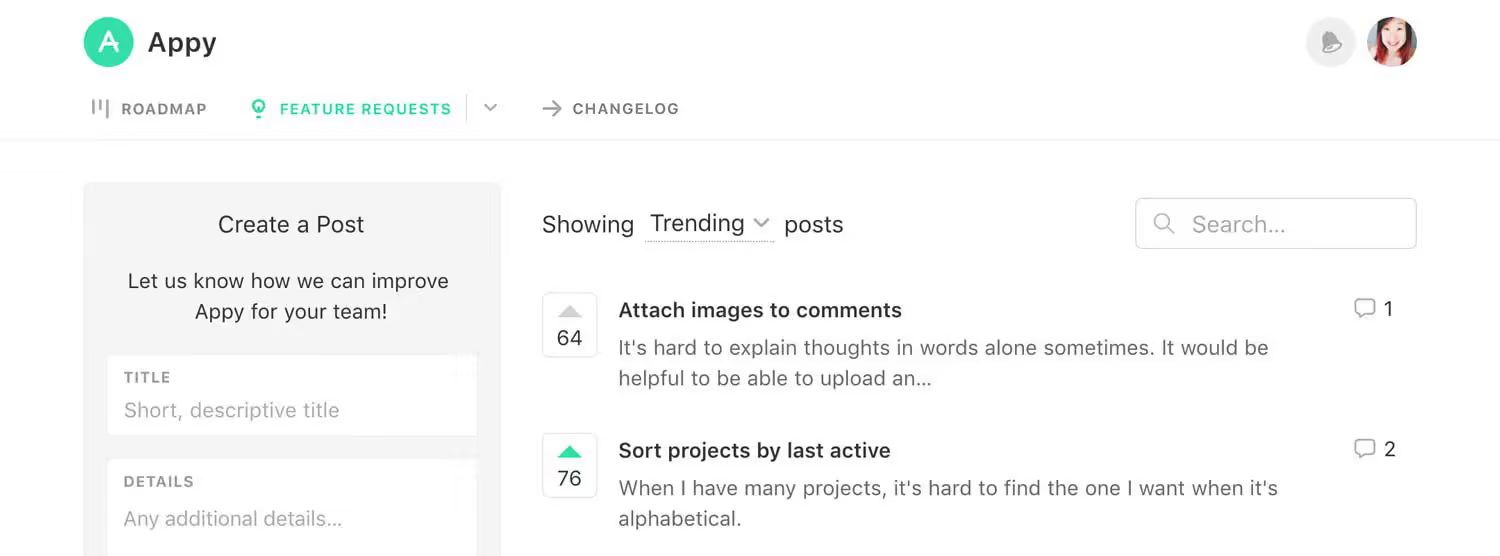
Product screenshot from Canny's feedback features. A focused portal is the product's strength; each new customer attached to that evidence can also affect the price.
The pricing model can work well for a B2B product with thousands of users and a deliberate research group. A five-person product team can invite Contributors freely, collect high-quality evidence from 100 customers, and pay $79 a month on annual billing.
The fit changes when participation is intentionally broad. A public roadmap shared with every customer, a high-volume consumer product, or Autopilot running across support and sales can make the tracked-user count the dominant cost. Canny advertises custom plans for high-volume B2C products, which is a sensible conversation to start before opening a board to a large audience.
There are also product boundaries. Canny can ingest survey responses and support conversations, but it is not a native NPS/CSAT survey platform or the inbox responsible for resolving support tickets. It does not replace onboarding or product analytics either.
If feedback is the job, compare Canny with other focused tools in our Canny alternatives guide. If the same purchase must connect feedback with surveys, support, announcements, onboarding, help content, and adoption measurement, compare broader customer-feedback platforms before adding another point solution.
What I would check before buying
I would take a sample from the systems where feedback already lives and count unique customers, not tickets or comments. That gives you a much better opening number than total product users.
Then I would ask Canny to confirm six points:
- Which events create a tracked user in every source we plan to connect?
- Does the count ever reset automatically, and how are merged or deleted users handled?
- Which Pro band covers today's count and a realistic 12-month count?
- What will customers and administrators see when our spending limit pauses new tracking?
- Which requirement would force Business, and which Business items are paid add-ons?
- What can we export if we later need posts, votes, comments, insights, roadmap state, and changelog history elsewhere?
If the answers produce a tracked-user forecast and a line-item quote, you have enough to compare. If the forecast is still based on admin seats or total MAU, the wrong unit is being modeled.
Verdict
Canny's $79 Pro price is a fair entry point for a focused feedback program with no more than 100 tracked users. The launch from the opening example, with 76 voters, fits that band and costs $948 for the first year. At 101 voters, the honest number is already $1,548.
Buy Canny for the quality of its feedback workflow, then budget by the number of customers who will become part of that workflow. If wider participation is the goal, model the next two bands before signing. If the buying job extends well beyond feedback, compare the cost of the surrounding tools as one system.
Sources and update note
Pricing, plan structure, tracked-user definitions, automatic upgrades, deletion behavior, and spending-limit behavior were checked on August 25, 2026 against Canny pricing, Canny's billing plans, tracked-user management, and Autopilot cap behavior. Verify the live quote before purchase.
Frequently asked questions about Canny pricing
Current answers about Canny plans, tracked users, billing bands, and buying tradeoffs.