









The most dangerous roadmap score is the one that makes a judgment call look like arithmetic.
AI can count requests, group related evidence, find an existing roadmap item, summarize product behavior, and prepare several options. It cannot decide which market you want to serve, which promise you are willing to make, or which valuable project should lose capacity.
Use AI to prepare the roadmap decision. Keep the decision itself owned by a person.
Prioritization starts after feedback analysis
Feedback analysis and roadmap prioritization are related, but they are not the same job.
AI feedback analysis asks whether several records describe one coherent customer problem. It produces reviewed themes with source evidence, affected segments, and confidence.
Roadmap prioritization asks a harder question: given this evidence, the product strategy, current behavior, delivery cost, risk, and existing commitments, what should the team do now?
A theme can be large and still be the wrong investment. It may come from customers outside the target market. It may describe an education problem rather than a missing feature. It may be strategically important but too uncertain to schedule. It may already be addressed by work in progress.
That is why the model should not jump from raw comments to a ranked roadmap.
Build a decision packet, not a magic score
A useful AI-assisted review creates one packet for each candidate problem.
| Part of the packet | Question it should answer |
|---|---|
| Problem statement | What job is failing, for whom, and in which context? |
| Customer evidence | Which reviewed feedback, support, research, or sales records support it? |
| Behavioral evidence | What do affected users actually do in the product? |
| Reach and severity | How many target accounts are affected, and how seriously? |
| Strategic fit | Which company or product objective would this advance? |
| Existing coverage | Is related work planned, in progress, shipped, or deliberately declined? |
| Options | What are the smallest credible responses besides building the requested feature? |
| Cost and risk | What would the work consume, delay, or expose? |
| Counterevidence | What suggests the team should not prioritize it now? |
| Recommendation | What should happen next, with confidence and assumptions stated? |
The packet can contain a score if your team uses RICE, weighted scoring, opportunity scoring, or another framework. The score should remain one input with visible assumptions.
If the model cannot show how it produced the inputs, it has not reduced uncertainty. It has hidden it.
The seven-step weekly operating loop
1. Freeze the decision context
Start each review with the state the team already owns:
- current product objectives
- target customer and excluded segments
- committed launches and contractual obligations
- active roadmap items and their latest status
- capacity or sequencing constraints
- decisions made in the previous review
This prevents the model from treating every week as a blank slate.
Version the context or record the review date. When the strategy changes, the team should be able to explain why the same evidence produced a different decision.
2. Bring in reviewed themes, not an unfiltered inbox
The prioritization review should consume themes that have already passed a basic evidence check.
Each theme should include:
- linked source records
- inclusion and exclusion rules
- unique affected accounts
- relevant segments and lifecycle stages
- recency and trend direction
- representative examples
- confidence and known ambiguity
This keeps duplicate requests from inflating demand and prevents one vague summary from becoming a roadmap candidate.
3. Map the theme to existing work
Before creating a new item, compare the theme with work that is:
- under research
- planned
- in progress
- recently shipped
- deliberately declined
- owned by documentation, onboarding, support, or another workflow
AI is particularly helpful here because wording changes between customer feedback and internal planning. A customer may ask for “weekly client reports” while the roadmap calls the related initiative “external dashboard sharing.”
The output should explain the match and link both records. It should not silently merge them.
4. Generate response options
Most product requests have more than two outcomes.
Ask the model to prepare options such as:
- run discovery with a defined segment
- fix a reliability or usability problem
- improve onboarding or contextual guidance
- update help content or support routing
- expose an existing capability more clearly
- build a smaller workflow before the full request
- accelerate related planned work
- monitor the signal until a threshold or date
- decline because it conflicts with strategy
This breaks the false choice between “put it on the roadmap” and “ignore the customer.”
5. Make counterevidence mandatory
An assistant will often produce a stronger argument when asked to recommend something. That is useful for drafting and dangerous for prioritization.
Require every packet to include:
- customers who do not experience the problem
- behavior that contradicts the written feedback
- reasons the request may be a solution looking for a problem
- existing work that could resolve the issue without a new feature
- assumptions that have not been tested
- the opportunity cost of acting now
A proposal without counterevidence is advocacy, not analysis.
6. Hold an accountable decision review
The model can prepare a recommendation such as:
- accelerate
- keep planned
- research next
- route outside the roadmap
- monitor
- decline
A named product owner should accept, change, or reject it.
Record:
- the decision
- the owner
- the evidence used
- the assumptions that mattered
- what would cause the team to revisit it
- what may be communicated to customers
This decision record is more valuable than the score. It lets future teams understand why an item moved and prevents the same debate from restarting with no memory.
7. Close the loop and measure the result
Different decisions require different follow-through.
- Research: contact the affected customers and define the unanswered question.
- Route elsewhere: update the help article, onboarding step, support workflow, or product copy.
- Plan: show the feedback-backed work in the appropriate roadmap view without publishing an unsupported date.
- Ship: notify the customers who asked and explain the outcome.
- Decline: preserve the reason and use honest language when a direct response is appropriate.
- Monitor: define the signal and date that will trigger another review.
After action, inspect whether the original problem changed. A completed ticket proves that work shipped. It does not prove the customer outcome improved.
Keep scoring legible
Scoring can improve consistency when the inputs are explicit.
It becomes misleading when the team combines estimates of different quality into one decimal number. “Reach” may come from product data, while “impact” comes from a workshop guess and “effort” comes from an early engineering estimate. Multiplying them does not make their uncertainty disappear.
Use these rules:
- Show the source beside every input.
- Use ranges when the evidence is uncertain.
- Separate observed facts from estimates.
- Record who supplied the estimate and when.
- Let reviewers see how the ranking changes under different assumptions.
- Never publish a score to customers as if it were a delivery promise.
AI can run the sensitivity analysis quickly. Ask which assumption most changes the ranking. That usually produces a better research question than another round of scoring.
A worked example
Imagine a B2B collaboration product reviewing a theme called “guest permissions.”
The reviewed evidence contains 31 records from 18 accounts. Most requests come from agencies and consultancies. Support history shows repeated workarounds. Product data shows that affected accounts invite guests successfully but later remove them or stop sharing sensitive projects.
A naive system might rank the theme highly and recommend building more permission controls.
The decision packet finds three plausible responses:
- Add a new granular permission model.
- Improve the existing role explanation and defaults.
- Create a separate client-view workflow that does not expose the internal workspace.
Counterevidence shows that many customers asking for permissions never changed the current default. Interviews are needed to distinguish a discoverability problem from a missing access model.
The decision becomes “research next,” with six target accounts, one prototype question, and a two-week review date.
The AI did not choose the roadmap. It helped the team avoid committing to the first solution named in the feedback.
What the agent may do automatically
Autonomy should depend on consequence, not convenience.
| Safe to prepare automatically | Require human review or approval |
|---|---|
| Group reviewed evidence into candidate packets | Change roadmap priority or status |
| Find possible matches with existing roadmap work | Create a customer-visible commitment |
| Draft options, counterevidence, and questions | Publish a roadmap update, reply, or announcement |
| Flag missing data and contradictory signals | Contact a customer about timing or scope |
| Produce an internal weekly summary | Move delivery capacity or cancel committed work |
| Draft a decision record after the meeting | Replace the accountable decision owner |
This boundary lets the system do substantial preparation while keeping consequential actions visible.
A reusable weekly prompt
The prompt should request evidence and uncertainty, not merely a ranked list.
Prepare this week's roadmap decision review.

Use only feedback themes that have linked source evidence and a completed human review.

For each theme:
1. State the customer problem, affected target segments, reach, severity, recency, and confidence.
2. Link the supporting records and summarize relevant product behavior.
3. Compare the theme with roadmap work that is planned, in progress, shipped, declined, or owned outside product development.
4. Produce at least two credible response options, including a non-feature response when appropriate.
5. Show counterevidence, missing information, strategic conflicts, delivery risk, and opportunity cost.
6. Recommend accelerate, keep planned, research next, route elsewhere, monitor, or decline.
7. State the assumptions that most affect the recommendation.

Do not change a roadmap record or publish customer-facing text. Draft the proposed updates for review.
Adapt the vocabulary to your own product process. The durable requirement is traceability from recommendation to evidence.
Measure the decision system
Do not optimize the loop around the number of AI-generated recommendations.
Track:
- time spent assembling each decision packet
- percentage of recommendations with linked source evidence
- themes matched to existing work instead of duplicated
- decisions routed to documentation, onboarding, or support instead of engineering
- reviewer overrides and why they happened
- time from decision to customer follow-up
- outcomes revisited after shipping
- decisions reopened because the original context was missing
The system is improving when the team reaches clearer decisions faster and can explain them later.
Where Userorbit fits
Userorbit keeps customer feedback, feedback-backed roadmap views, announcements, support context, and adoption signals within one product-experience layer. Its AI-assisted workflows can summarize and group product needs, while its API and hosted MCP server give compatible assistants structured access to documented product resources.
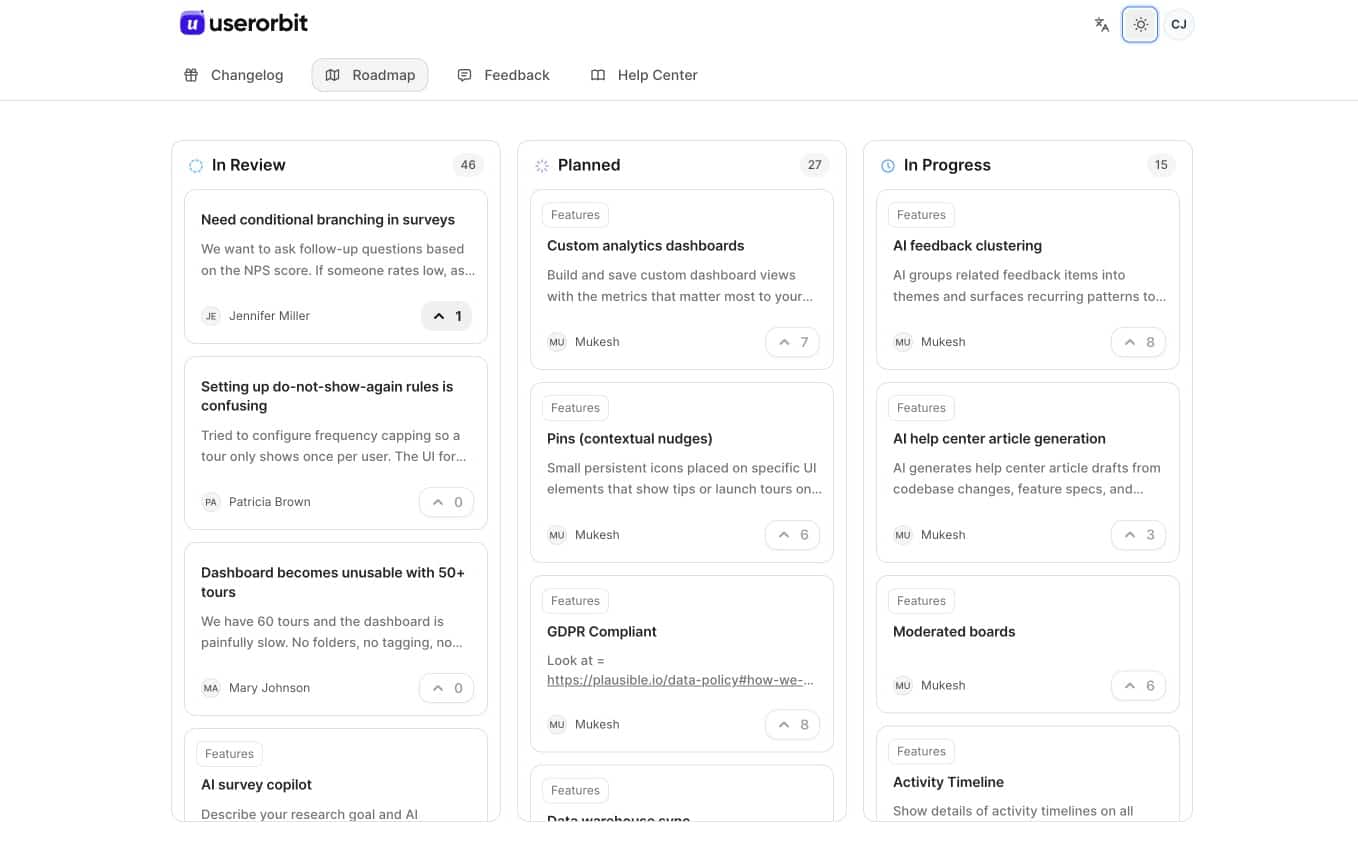
That makes the preparation loop practical: collect evidence, assemble the packet, propose the update, review it, and keep the customer-facing action under human control.
The product does not remove product judgment. It reduces the context transportation surrounding it.
Capability note: these Userorbit references were checked against current public product information on August 30, 2026. Strategy, effort, customer attributes, and behavioral context must still be supplied or connected; the system should not invent them.
Compare the best product roadmap software for SaaS or review how Userorbit's feedback-backed roadmap works.
Start with one decision
Choose one disputed roadmap candidate from the next review.
Build the packet. Make counterevidence mandatory. Ask the model to show which assumption most affects its recommendation. Then have the accountable product owner record the decision and the condition that would reopen it.
The point of AI roadmap prioritization is not to make judgment disappear.
It is to make the judgment visible.
Frequently asked questions about AI roadmap prioritization
Practical answers for product teams adding AI to roadmap decisions.