








AI can make a feedback backlog look organized long before it makes the evidence trustworthy.
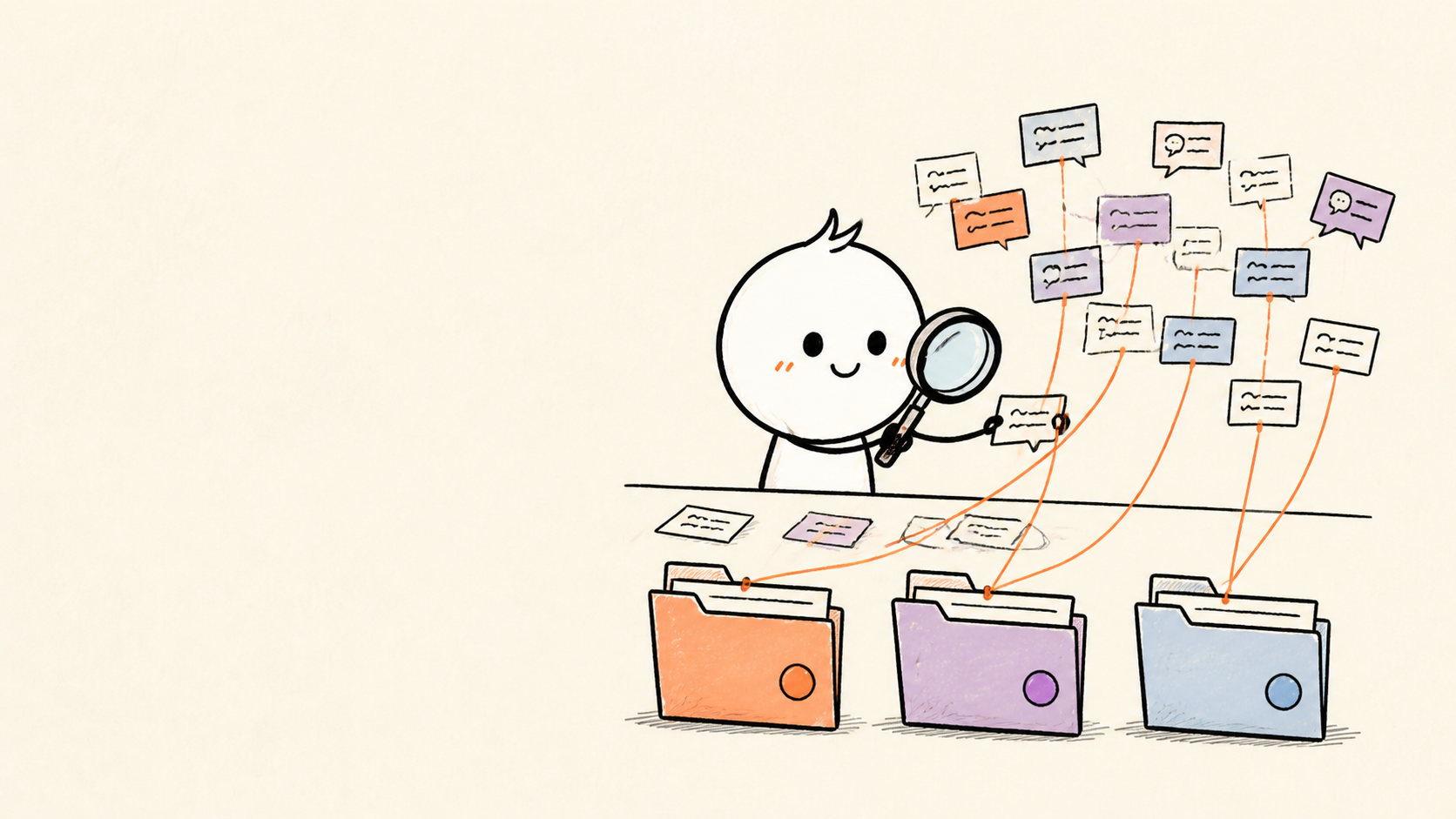
A polished summary is easy. A defensible theme is harder. It must preserve the original customer language, explain why several records belong together, show which users are affected, expose contradictory evidence, and remain useful after the team decides what to do.
That is the practical role of AI feedback analysis: compress the work required to prepare evidence without pretending the model owns the product decision.
The output is not a summary
Most feedback analysis starts with a reasonable request: “Summarize what customers are saying.”
The result often sounds useful. Customers want simpler onboarding, better reporting, more integrations, and faster performance. Unfortunately, almost every SaaS product could receive the same summary.
The problem is not the prose. It is the missing chain of evidence.
A product team needs to know:
- which original records support the theme
- whether the records describe the same problem or merely use similar words
- which accounts, roles, plans, and lifecycle stages are affected
- whether product behavior supports or contradicts the written feedback
- what changed since the previous review
- which action the evidence can reasonably support
AI feedback analysis is valuable when it produces that structure. Summarization is only one step inside it.
Use an evidence ladder
A reliable workflow moves through six layers:
- Original signal: the unedited request, survey answer, support message, call note, or observed behavior.
- Structured record: the signal plus its source, customer, account, date, product area, and lifecycle context.
- Candidate theme: a proposed grouping with a name and explicit inclusion rule.
- Reviewed evidence: representative records, exceptions, duplicates, segment distribution, and confidence.
- Decision packet: the evidence combined with strategy, reach, cost, risk, and existing commitments.
- Outcome: the research, product change, documentation, communication, or deliberate non-action that followed.
The model can accelerate layers two through five. Humans remain responsible for what the evidence means and which tradeoff the company accepts.
This distinction prevents a common failure: turning “the model found a large cluster” into “the roadmap should prioritize it.” Cluster size describes the evidence set. It does not settle the decision.
Start with an input contract
Feedback arrives through different channels because customers are doing different jobs.
A board post is an explicit request. A support message usually represents blocked work. A survey answer responds to a question your team chose. A sales note may describe buying friction. A product event records behavior without explaining motive.
Do not flatten those sources into anonymous text before analysis.
| Field | Why it matters |
|---|---|
| Original text or event | Keeps the analysis auditable |
| Source and source URL | Reveals how the signal was produced |
| Customer and account | Supports follow-up and prevents double counting |
| Role, plan, and segment | Shows who experiences the problem |
| Product area and journey stage | Separates similar language from different workflows |
| Created and last-seen dates | Distinguishes persistent demand from a temporary spike |
| Usage context | Tests whether stated feedback matches observed behavior |
| Existing feedback or roadmap link | Prevents the system from rediscovering known work |
| Visibility and sensitivity | Controls what the model and reviewers may access |
If a field is unavailable, mark it as unknown. Do not ask a model to invent the missing context.
For a broader collection strategy, read The Complete Guide to Feedback Collection. The analysis will only be as representative as the signals it receives.
A six-step AI feedback analysis workflow
1. Preserve the raw evidence
Store the original record before cleaning or classification. Keep a stable identifier and a link back to the source.
This gives reviewers a way to inspect the customer's actual words, recover from a poor classification, and re-run the analysis when the taxonomy changes.
Remove secrets and unnecessary personal data before sending records to a model. The analysis rarely needs credentials, payment details, private attachments, or the full history of an account.
2. Normalize without erasing meaning
Normalization should make records comparable, not make every customer sound the same.
Useful transformations include:
- detecting language and translating into a review language while retaining the original
- separating a record into problem, requested solution, affected workflow, and claimed impact
- mapping product names and common synonyms to one vocabulary
- identifying obvious spam, test data, and operational messages
- marking uncertainty when the record lacks enough context
Keep the customer's requested solution separate from the underlying problem. “Add a CSV export” may mean the reporting view is weak, the API is inaccessible, or a stakeholder needs a weekly artifact. Those problems may require different responses.
3. Create candidate themes with boundaries
A useful theme needs more than a label.
For each candidate, require the system to provide:
- a short name written in customer-problem language
- an inclusion rule
- an exclusion rule
- the linked source records
- two or three representative examples
- nearby themes that reviewers may confuse with it
- a confidence level and the reason for it
For example, “dashboard sharing” might include requests to send a live dashboard to an external stakeholder. It should exclude requests for scheduled CSV exports if the customer is trying to feed another system rather than share a view.
Boundaries make themes stable enough to compare over time.
4. Separate confidence from priority
AI can estimate how confidently a record belongs to a theme. It should not hide business judgment inside that score.
Keep two layers visible:
| Analysis question | Possible evidence |
|---|---|
| How confident are we that this is one coherent problem? | Semantic similarity, reviewer agreement, stable inclusion rules |
| How broad is the signal? | Unique accounts, roles, segments, and recency |
| How severe is the problem? | Blocked workflows, repeated support, churn or expansion context |
| What behavior is associated with it? | Drop-off, failed actions, low adoption, repeated attempts |
| Does it fit the strategy? | Target customer, product direction, current commitments |
| What would action cost or displace? | Research, design, engineering, support, and opportunity cost |
The first question is an analysis-quality question. The others belong in prioritization.
5. Review the model, not only the themes
Human review should test the system where it is most likely to fail.
Sample:
- high-volume themes
- low-confidence assignments
- records moved between themes
- themes with unusually fast growth
- strategic accounts and severe support cases
- records the system marked as irrelevant
Look for false merges, missed duplicates, dominant customers overwhelming the count, and wording that changed the original meaning.
Reviewers should be able to split, merge, rename, and reject themes while preserving the audit trail. Their corrections become evaluation cases for the next run.
6. Route the result into a real decision
Every reviewed theme needs an owner and a next state.
Common destinations include:
- product discovery or roadmap review
- a bug or reliability investigation
- an onboarding or in-product guidance change
- a help article or support workflow update
- a customer follow-up
- an announcement or changelog entry after a related release
- monitor with a review date
- decline with a recorded reason
This is where analysis becomes operational. A theme dashboard that nobody acts on is a more attractive backlog, not a better feedback system.
A worked example
Consider a hypothetical B2B dashboard product.
The system receives 46 records containing phrases such as “weekly report,” “send this to my client,” “PDF,” “email dashboard,” and “scheduled export.” A keyword approach may merge all 46 into one reporting theme.
A reviewed analysis finds three different jobs:
- Agencies want a branded, view-only link for clients.
- Operations teams want scheduled data delivery into another system.
- Executives want a stable weekly snapshot for a meeting.
The language overlaps. The required products do not.
Behavior adds another useful distinction: the agency group creates dashboards successfully but struggles at sharing; the operations group repeatedly visits API and export settings; the executive group rarely logs in after the dashboard is configured.
The correct output is not “reporting is the top request.” It is three evidence-backed problems with different affected users, behaviors, and possible responses.
Evaluate the analysis like a product feature
Do not judge the system by how convincing the summary sounds.
Maintain a small reviewed dataset and test:
- Assignment precision: Of the records placed in a theme, how many belong there?
- Theme recall: Which important reviewed records did the system miss?
- Duplicate quality: Did it merge repeated evidence without erasing distinct customers?
- Stability: Does a theme remain recognizable when new records arrive?
- Traceability: Can a reviewer move from every claim to the source records?
- Segment integrity: Are large or vocal accounts distorting the apparent breadth?
- Actionability: Did the output reach an owner and produce a decision or follow-up?
Also track corrections. A falling correction rate within a stable taxonomy is more useful than a growing number of generated themes.
What AI should not decide
Feedback is evidence, not a referendum.
Do not delegate these decisions to the model:
- which customer segment the company will serve
- which strategy or market tradeoff to accept
- whether a request becomes a promise
- whether a public roadmap status should change
- whether customer-facing language is safe to publish
- whether a high-value exception outweighs broad demand
AI can assemble the packet, show the assumptions, and surface counterevidence. A product leader should own the decision and its consequences.
Where Userorbit fits
Userorbit keeps feedback boards, surveys, roadmap work, support context, announcements, onboarding, and analytics within the same product-experience system.
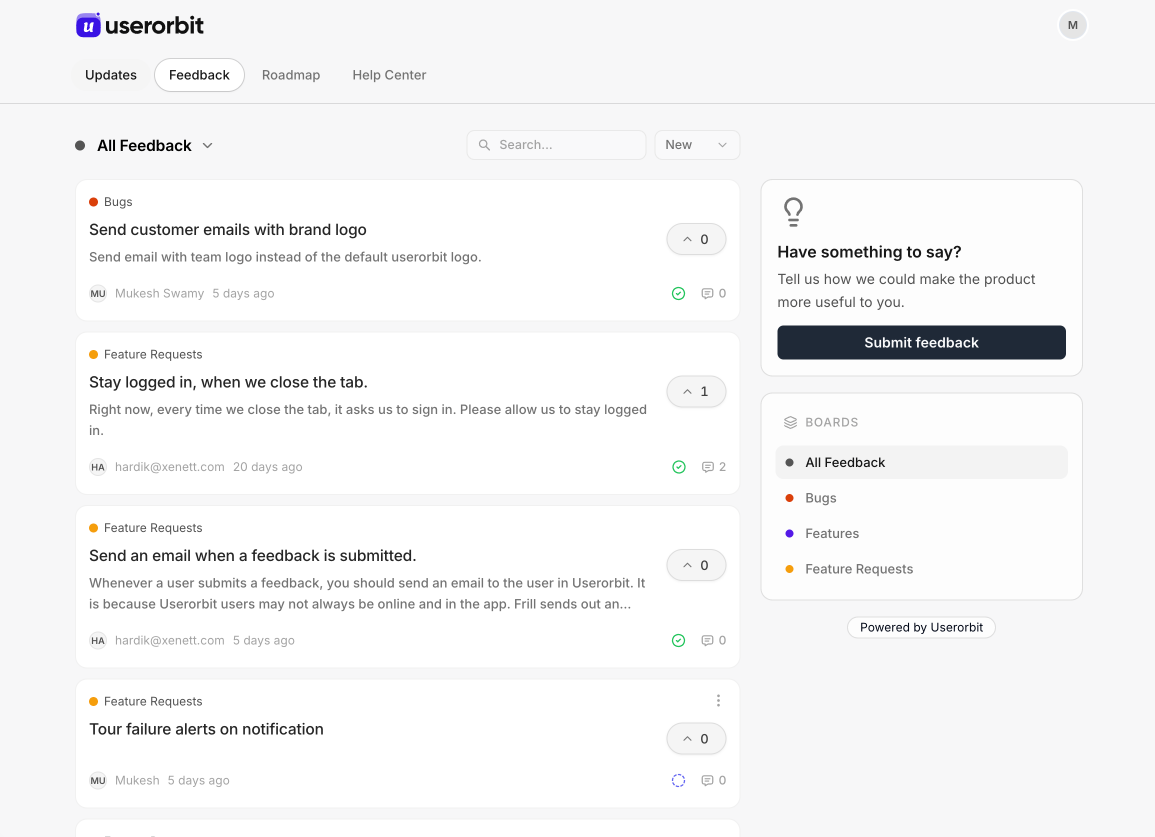
That shared context shortens the path from a customer signal to a reviewed decision. Teams can summarize feedback, group related product needs, retain customer context, connect evidence to roadmap work, and then communicate what changed without rebuilding the story in a separate tool.
The operating model remains human-controlled: prepare the evidence, review the proposed action, approve customer-facing communication, and measure what happened next.
Capability note: these Userorbit references were checked against current public product information on August 30, 2026. Available context still depends on what your workspace has collected and connected.
See how Userorbit closes the customer feedback loop or compare the best customer feedback tools for SaaS.
A practical starting sequence
Start smaller than your backlog.
- Choose one product area and the last 100–300 feedback records.
- Define five to ten reviewed themes with inclusion and exclusion rules.
- Run the AI analysis and inspect the highest-confidence and lowest-confidence assignments.
- Attach account and product-behavior context.
- Produce one decision packet with source links and counterevidence.
- Record the decision and review the theme again after the team acts.
The goal is not to remove people from feedback analysis. It is to spend less human attention transporting evidence and more of it deciding what the evidence means.
Frequently asked questions about AI feedback analysis
Practical answers for product teams introducing AI into customer-feedback work.