








You don't need a Chameleon quote to know whether the entry plan is too small. You need to count two things first: every user profile Chameleon can identify and every Experience your team expects to keep live.
As of August 24, 2026, Chameleon's public pricing page shows Startup from $279 per month for 2,000 Monthly Tracked Users (MTUs), Pro from $750 per month for 5,000 MTUs, Growth from $1,250 per month for 5,000 MTUs billed annually, and Enterprise with custom pricing.
The short answer: shortlist Chameleon when design control, embedded guidance, experimentation, and governance matter enough to justify a premium adoption tool. Pro is the honest planning tier for most established product teams. Growth becomes the real budget when you need unlimited live Experiences, HelpBar, full Interactive Demos, or dedicated onboarding.
Every volatile price and limit in this guide was checked against Chameleon's official pages on August 24, 2026. Public arithmetic is not a quote; confirm your MTU tier, add-ons, and contract terms before buying.
The decision in 60 seconds
Choose Startup if you have fewer than 2,000 MTUs, six or fewer teammates, and no more than 10 Experiences live at once.
Choose Pro if you need A/B testing, up to 20 live Experiences, more teammates, or localization across five languages without an annual sales-led contract. Verify the exact Goals entitlement during the trial because Chameleon's current official pages disagree.
Budget for Growth if you need unlimited Experiences, HelpBar, full AI Interactive Demos, the Ranger governance agent, or dedicated Customer Success and onboarding.
Start an Enterprise conversation if full role-based permissions, multi-product Accounts, unlimited environments, first-party implementation, or custom procurement terms decide the purchase.
Compare alternatives if your main need is deep product analytics, native mobile engagement, a focused tour builder, or a connected system spanning feedback, roadmap, announcements, help content, support, and adoption.
What does Chameleon cost in 2026?
Chameleon's visible entry points are more useful than a fully custom pricing page. They still do not show the complete bill at higher usage.
The current public plan cards and comparison table support this buying view:
| Plan | Public starting price | Billing | Best fit | Main catch |
|---|---|---|---|---|
| Startup | $279/month for 2,000 MTUs | Monthly | Small teams running one focused in-app program | 10 live Experiences and six teammates; confirm availability and billing cadence |
| Pro | $750/month for 5,000 MTUs | Monthly | Product teams running guidance and experiments | 20 live Experiences; HelpBar and the Ranger agent are not included |
| Growth | $1,250/month for 5,000 MTUs | Annual | Cross-functional adoption programs | $15,000 annual base commitment before add-ons and overages |
| Enterprise | Custom | Annual | Multi-product and procurement-heavy organizations | The base price and MTU allowance are not public |
The visible prices are the start of the model. Chameleon says pricing scales with the maximum MTU count in the billing period, and MTU overages can appear on the next invoice.
Is there a free plan?
The current main pricing page does not show an ongoing free plan for published in-app Experiences. It offers a 14-day full-platform trial with no credit card.
Chameleon's Experience documentation also references free basic Interactive Demos and HelpBar. Treat that as a separate free product surface, not proof that tours, surveys, or Launchers can stay live for free.
During the 14-day trial, Chameleon says you can use Pro, Growth, and Enterprise features with unlimited trial seats. If you do not choose a paid plan, live Experiences are unpublished, but the account and data remain intact.
Why MTUs are the number to model first
Chameleon's billing meter is broader than “people who saw a tour.”
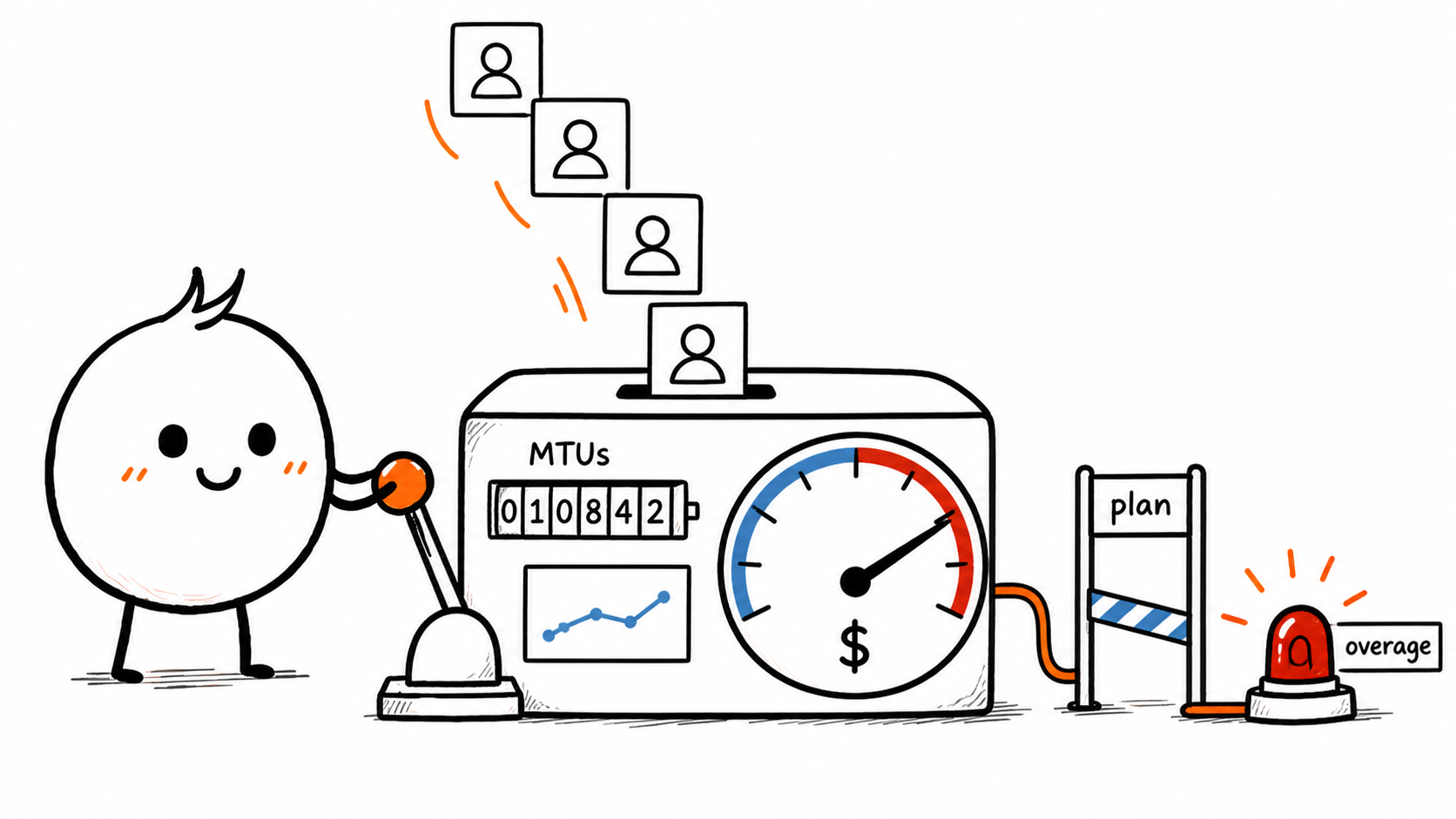
An MTU is any unique user profile identified to Chameleon from any source during a rolling 30-day period. According to Chameleon's billing definition, that can include users sent through:
- the Chameleon JavaScript snippet;
- client-side or server-side Segment calls;
- integrations, webhooks, or the REST API;
- manual user updates;
- anonymous IDs that your team creates.
An identified user can count even if they never see a Chameleon Experience. Sending marketing-site visitors or inactive profiles through the wrong integration can therefore increase the bill without expanding the audience you intended to guide.
A stable user ID prevents one person from being counted again across browsers or devices. Inconsistent IDs can do the opposite.
The hidden meter is identification, not exposure. Audit every source that can create a Chameleon profile before you accept an MTU allowance.
What happens when you exceed the limit?
The answer depends on the plan.
- Pro: usage moves through graduated MTU tiers. A higher tier reached during the month is reflected on the next invoice.
- Growth and Enterprise: the contract includes an MTU allowance. Going above it in a month creates an overage on the next invoice, even though the plan is billed annually.
- Startup: Chameleon applies its standard price for the month's MTU overage.
Chameleon does not publish the graduated Pro schedule or the per-MTU overage rates for Startup, Growth, or Enterprise. That makes exact math above the visible base tiers impossible without a quote.
For legacy context, Chameleon says accounts created before March 28, 2021 may still use Monthly Active Users rather than MTUs. New buyers should plan around MTUs.
When does Startup work?
Startup works when your adoption program is small by design, not merely small today.
The Startup plan documentation lists:
- 10 live Experiences across Tours, Tooltips, Embeddables, Microsurveys, and Launchers;
- six teammates;
- Copilot;
- themes and custom CSS;
- audience segments and scheduling;
- Experience analytics and environment display control.
Separate Experience docs list five Embeddables, five Microsurveys, and one Launcher within Startup packaging. That Launcher can act as an onboarding checklist or resource center.
A realistic fit is one product with one primary onboarding path, a few announcements or surveys, and one small team publishing the work. Startup becomes tight when product, growth, and customer success all want their own live campaigns.
There is also a public-page ambiguity. The pricing page invites small teams to start Startup, while the help article describes it as a plan for “existing Startup customers.” Ask whether a new account can buy it before building a procurement model around $279.
When is Pro the honest planning tier?
Pro is the practical tier for a design-sensitive SaaS team that wants Chameleon's experimentation toolkit without an annual Growth contract.
The Pro plan includes 20 live Experiences, themes and custom CSS, A/B testing, goals, five localization languages, 20 tracked custom events, two rate limits, four environments, integrations, webhooks, APIs, and the MCP server.
It includes 10 working seats, while Viewers are unlimited. A bundle of five extra seats costs $300 per month, and Pro can expand to 20 working seats before an upgrade is required.
Pro has three planning constraints:
- Twenty live Experiences can become an operating limit. Count simultaneous tours, Tooltips, Embeddables, Microsurveys, and Launchers across every team.
- HelpBar and Ranger are not included. If self-serve search or automated governance is a day-one requirement, start the comparison at Growth.
- The exact goal entitlement needs confirmation. The current pricing page lists A/B testing and Goals on Pro, while an analytics help article says conversion Goals are available on Growth or Enterprise. Bring the specific goal type to the trial.
Chameleon's pricing FAQ calls Pro self-serve. If implementation coaching or a response-time commitment matters, ask what support is included before choosing the monthly plan.
When does Growth become the real budget?
Growth is not just Pro with higher limits. It changes the operating model and the contract.
The Growth plan adds:
- unlimited live Experiences;
- full AI Interactive Demos;
- HelpBar;
- the Ranger governance agent;
- 10 localization languages;
- dedicated Customer Success and onboarding;
- expert coaching and unlimited asynchronous feedback on Experiences;
- security questionnaire support and a redlined MSA.
Growth includes 15 working seats and unlimited Viewers. A five-seat bundle costs $3,000 per year, and the account can reach 25 working seats before Enterprise is required.
The public base is $15,000 per year. That is the minimum useful cash-commitment number, not $1,250 as if the plan were cancelable monthly.
Use Growth when campaign volume, governance, self-serve help, or hands-on onboarding already belongs in the requirement. Do not use it only because your team assumes “unlimited” will be safer. The plan still has 20 custom events, two rate limits, four environments, and a contracted MTU allowance.
What changes on Enterprise?
Enterprise is the governance and implementation tier, not a public price band.
Chameleon's Enterprise documentation adds full Roles & Permissions, multi-tenancy, unlimited localization, unlimited rate limits and environments, 50 tracked custom events, unlimited teammates, account switching, a customized subdomain, and first-party implementation.
The public comparison table also lists $5,000 per year for each additional Chameleon Account. This matters when separate products, legal entities, or business units need their own governed workspace.
The base price, included MTUs, overage schedule, implementation scope, support SLA, and contract length are custom. Ask for those as separate lines instead of accepting one blended number.
What would realistic accounts pay?
The only defensible public scenarios use the disclosed starting tiers and add-ons. These totals exclude taxes, overages, negotiated services, and internal implementation labor.
| Scenario | Public planning number | What it covers | What remains unknown |
|---|---|---|---|
| Small web SaaS | $279/month; $3,348 across 12 months | Startup, up to 2,000 MTUs, 10 live Experiences, six teammates | New-buyer eligibility, overage rate, SSO price, exact cancellation terms |
| Experimenting product team | $750/month; $9,000 across 12 months | Pro, up to the visible 5,000-MTU entry tier, 20 live Experiences, 10 working seats | Higher MTU tiers, support SLA, discounts |
| Pro with SSO | $13,800 across 12 months | Pro base plus the disclosed $400/month SAML SSO add-on | MTU overages and any negotiated commitment |
| Cross-functional program | $15,000/year | Growth base at the visible 5,000-MTU entry tier | Included headroom, overage rate, renewal terms |
| Growth with SSO and five extra seats | $22,000/year | Growth base, $4,000/year SSO, $3,000/year seat bundle | MTU overages, taxes, implementation scope |
| Multi-product organization | Custom base, plus disclosed add-ons | Enterprise; SSO is listed at $4,000/year and additional Accounts at $5,000/year each | Nearly every useful total-cost input |
The takeaway is simple: model the package your team will operate, not the lowest card it can technically buy.
Where can the bill change?
Five axes can move Chameleon's cost or force a plan change.
1. MTU growth and data plumbing
MTUs can rise through product growth, a second product, a new domain, or an integration that introduces profiles your team did not intend to count. Monitor the Billing export and filter upstream sources before a launch spike.
2. Live Experience volume
Startup allows 10 live Experiences and Pro allows 20. Count the full portfolio, not one team's roadmap. A tour, survey, Launcher, banner, or embedded message can all consume operating room.
3. Seats and SSO
The public SSO pricing is material:
- Pro: $400/month;
- Growth: $4,000/year;
- Enterprise: $4,000/year.
Chameleon says SSO is available as an add-on on every plan, but the current page does not show a Startup SSO price. MFA is available across plans without the SSO add-on.
4. Implementation and maintenance
The builder is no-code after the foundation exists. Chameleon's setup checklist still calls for engineering help to install the snippet and sync user identity or targeting data.
Budget ownership for event naming, identity QA, CSS review, targeting, localization, and Experience cleanup. Growth includes dedicated onboarding; Enterprise includes first-party implementation. Pro and Startup leave more of that operating work with your team.
5. Contract and renewal terms
Chameleon's online terms, last updated February 2025, say standard services are charged in advance, prices can change, upgrades are prorated, taxes are extra, and monthly tiers renew unless canceled before the next month.
Growth and Enterprise use annual redlined MSAs according to the current pricing page. Your signed order form may differ from the generic terms, so ask about the renewal uplift, cancellation notice, overage schedule, and downgrade path.
No official page reviewed on August 24, 2026 published an annual discount, startup discount, nonprofit discount, or multi-year discount. Ask, but do not put a guessed discount into the budget.
Three filters before the demo
Some requirements should remove or reshape Chameleon before a team spends time comparing builders.
Native mobile
Chameleon is built for browser-based products, including SPAs and mobile web. Its compatibility documentation says native mobile applications are not currently supported.
If iOS or Android guidance is required, compare a platform with native mobile support before evaluating Chameleon's visual controls.
Analytics depth
Chameleon reports Experience starts, completions, exits, clicks, survey actions, goals, experiments, and an Engagement Index. It can export data and send events to analytics tools.
That is useful Experience analytics. It is not automatically a replacement for a product analytics system built around deep funnels, cohorts, paths, warehouse analysis, or session replay. Decide whether you want to execute adoption, analyze the whole product, or do both.
Security and data location
Chameleon states that it received a clean SOC 2 Type II attestation in January 2026, stores data in US-based databases encrypted at rest, and targets 99.9% uptime. These are vendor claims; request the report, DPA, subprocessor list, and SLA during review.
Chameleon also says it is not HIPAA certified. If protected health information or non-US data residency is required, resolve that before installing the snippet.
Where does Chameleon fit?
Chameleon deserves a shortlist when the in-product Experience itself is part of the product design.
It is strongest for teams that need:
- highly styled tours, Tooltips, Embeddables, surveys, and Launchers;
- contextual targeting and display control;
- A/B testing tied to in-app guidance;
- several localization markets;
- governance over a growing Experience portfolio;
- HelpBar and Interactive Demos in the same adoption platform.
It is less compelling when the buying job is only a basic checklist, when native mobile is mandatory, or when the team expects one product to own deep analytics, feedback management, public roadmap, changelog, support, and onboarding together.
Which alternatives should you compare?
Choose the comparison set by operating job. As of August 24, 2026, the official pricing pages show Userflow Adoption Studio at $500/month on monthly billing, Userpilot Starter at $299/month for 2,000 MAUs, and Appcues with sales-led pricing based on MAUs, installations, and published Experiences. Userorbit pricing shows Growth at $95/month on annual billing for 5,000 MAUs and Scale at $249/month for 10,000 MAUs.
| Option | Compare it when... | Watch for |
|---|---|---|
| Chameleon | Design control, embedded guidance, experimentation, and governance are central | MTUs, live-Experience limits, SSO, annual Growth contract |
| Userflow | You want a focused web onboarding builder and clear product boundaries | Adjacent feedback, roadmap, and communication tools may remain separate |
| Userpilot | Product analytics and in-app engagement belong in one evaluation | The deeper analytics value begins on the more expensive Growth tier |
| Appcues | Onboarding is part of a wider lifecycle engagement program | Dollar pricing is not public, and usage includes more than MAUs |
| Pendo | Enterprise analytics, governance, and portfolio reporting outweigh pricing transparency | Paid pricing is custom and the platform may exceed a simple onboarding job |
| Userorbit | Onboarding must connect with feedback, roadmap, announcements, changelog, surveys, help content, support, and analytics | Newer than long-established adoption incumbents |
| Open-source library | Engineering ownership is acceptable and you only need product guidance | Maintenance, analytics, targeting, accessibility, and QA stay with your team |
Userorbit publishes this guide, so our access to Userorbit is deeper than our access to Chameleon or the other vendors. The Chameleon analysis uses public official sources, not a private product trial or customer contract.
If your need is narrow, a specialist can be the better purchase. Use the onboarding pricing comparison for the category view and the open-source product tour guide if build ownership is still on the table.
If the real job spans the customer's whole journey, compare Userorbit and Chameleon by workflow rather than by tour-builder features alone.
What should you ask before signing?
Bring these questions to the trial, sales call, and security review.
- Which systems can create or update a Chameleon user profile?
- What were our maximum rolling 30-day users in the last 12 months?
- Which anonymous, internal, test, marketing-site, and inactive users can be excluded?
- What is the complete MTU tier or overage schedule for our plan?
- Do overages reset next month, or change our contracted tier?
- How many Experiences need to be live across every team and environment?
- Which exact goal, experiment, HelpBar, Demo, and localization features do we need?
- How many Creators, Designers, Publishers, Engineers, Admins, and Viewers need access?
- Is SAML SSO required, and is it priced separately on our order form?
- What does onboarding or first-party implementation deliver, and what remains with engineering?
- Which data location, DPA, SOC 2, HIPAA, or SLA requirements apply?
- Are multiple products covered by one Account, or billed as additional Accounts?
- What discount, price lock, renewal uplift, and cancellation notice will appear in the contract?
- Which adjacent workflows still require another tool after Chameleon is live?
The answers should produce a line-item budget and an operating plan. If they only produce a feature demo, the evaluation is not finished.
Bottom line
Chameleon's $279 Startup price is a credible entry point for a small web product, subject to confirming new-buyer availability. Pro at $750 per month is the more realistic plan for teams running experiments and more than one onboarding motion. Growth starts at a $15,000 annual commitment when unlimited Experiences, HelpBar, governance, or dedicated onboarding become requirements.
Shortlist Chameleon when polished, controlled in-product guidance is the job. Compare analytics-led platforms when product insight is the job. Compare Userorbit when onboarding must connect with the wider feedback, roadmap, announcement, help, support, and adoption workflow.
Need more than a tour builder?
Sources and update notes
Pricing, packaging, billing behavior, compatibility, security, and legal details were checked against Chameleon's official pricing, help, product, privacy, security, and terms pages on August 24, 2026. Alternative prices were checked against each vendor's official pricing page on the same date.
We did not use a private Chameleon quote, logged-in product access, customer interview, or controlled product test. Vendor compliance statements remain vendor claims until a buyer reviews the underlying documents.
Frequently asked questions about Chameleon pricing
Direct answers about Chameleon plans, MTUs, overages, trials, and alternatives in 2026.