










Open-source product tour libraries solve a very specific problem.
You need onboarding in the product. You need a spotlight, a tooltip, a short guided flow, maybe a checklist later. You do not want to buy a full platform on day one. You want code, control, and a fast path to shipping. That is a sensible instinct and It is also where teams get trapped.
The library gets you the first tour. Then you need targeting. Then analytics. Then localization. Then experiments. Then someone asks for a changelog, a checklist, or role-based onboarding. Suddenly the cheap choice starts collecting hidden cost in engineering time.
That does not mean open source is the wrong move. It means you should choose the right library for the stage you are in.
This guide compares the best open-source product tour libraries in 2026, which ones are actively usable, which ones come with licensing or maintenance caveats, and which kind of team each option fits.
What to look for in an open-source product tour library
Most teams compare demos and star counts.
That is not enough.
A better evaluation framework looks at five practical questions:
- How much control do you need? Some libraries are bare infrastructure. Others give you higher-level components and opinionated flows.
- Does it match your stack? A React team should not force a framework-agnostic library if the wrapper quality is poor. A vanilla JS team should not drag in React-only assumptions.
- How active is maintenance? Product tours touch DOM structure, routing, overlays, focus management, and accessibility. Stale libraries age badly.
- What is the license? "Open source" is not one bucket. MIT and Apache are very different from AGPL when legal review shows up.
- Will you outgrow it in six months? A library can be perfect for shipping the first walkthrough and still be the wrong long-term answer for onboarding at scale.
Quick comparison table
| Library | Best for | Strength | Watch out for | License |
|---|---|---|---|---|
| Shepherd.js | Custom web apps with complex flows | Flexible API and polished step control | You still build targeting and analytics yourself | MIT |
| Driver.js | Lightweight highlighting and simple tours | Tiny mental model and fast setup | More primitive if you need richer onboarding patterns | MIT |
| Intro.js | Teams that want a mature guided-tour API | Established project and broad usage | AGPL for open-source usage, paid license for many commercial cases | AGPL v3 / commercial |
| React Joyride | React teams that want quick adoption | Familiar React workflow and active ecosystem usage | Styling and state orchestration can get messy at scale | MIT |
| Reactour | React apps that want component-level control | Good React-native-feeling API for guided flows | Best if your product already lives deep in React patterns | MIT |
| Onborda | Next.js teams | Built for modern Next.js apps and route-aware tours | Newer project with a narrower audience | MIT |
| Hopscotch | Nobody building something new | Historical reference only | Archived and not a serious choice in 2026 | Apache 2.0 |
Best open-source product tour libraries in 2026
1. Shepherd.js
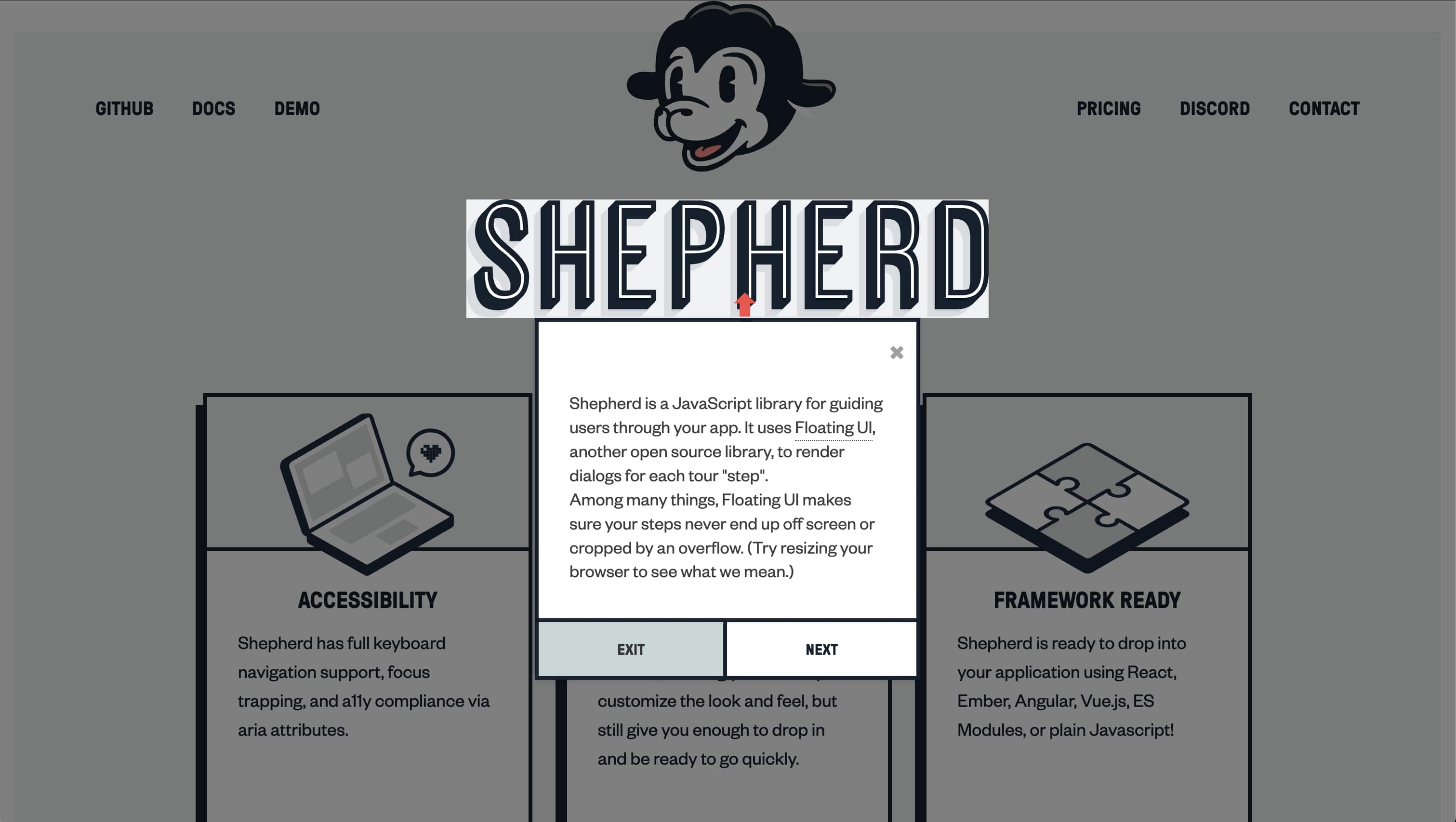
Shepherd.js is still one of the strongest open-source product tour libraries if your team wants serious control without adopting a full onboarding platform.
It gives you a flexible step system, reliable positioning, modal overlays, keyboard navigation, and enough API surface to build something that feels product-grade rather than hacked together.
Why teams pick Shepherd.js
- strong control over step behavior and placement
- polished enough for production UI
- framework-agnostic core
- good fit for multi-step tours with branching logic handled in your app
- widely referenced by developers who need something sturdier than a one-file plugin
Where it works well
Shepherd.js is a good choice when your product team already has engineering support and wants onboarding that matches an existing design system.
It is less ideal if your real need is a broader onboarding stack with segmentation, analytics, localization, and experimentation handled out of the box.
Best for: Product teams building custom onboarding inside a web app with ongoing developer ownership.
2. Driver.js
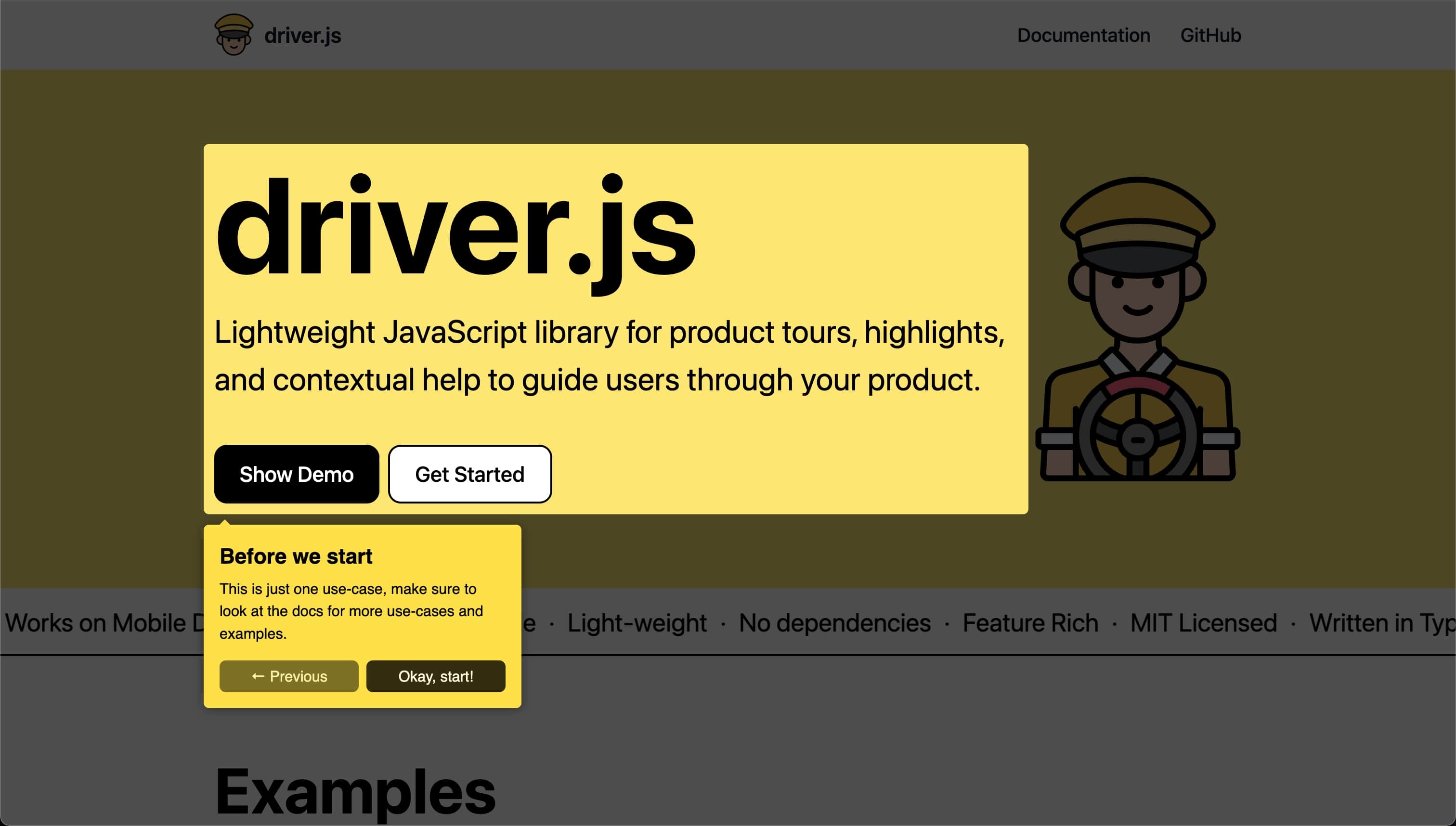
Driver.js has a very different personality.
It is lean, focused, and refreshingly direct. If your team mainly needs highlighting, guided emphasis, and simple walkthroughs, Driver.js is often the fastest way to get there.
Why teams pick Driver.js
- low setup friction
- clean highlighting behavior
- no-dependency feel appeals to teams that hate bloated UI tooling
- simple API that is easy to explain to new contributors
- good fit for feature callouts and short product nudges
Where it works well
Driver.js shines when the job is guiding attention, not building a whole onboarding operating system.
That distinction matters. A lot of teams do not need a massive framework for the first version. They need a reliable spotlight and a few steps that do not break.
Best for: Lean product and engineering teams that want simple tours, hints, and feature highlights with minimal overhead.
3. Intro.js
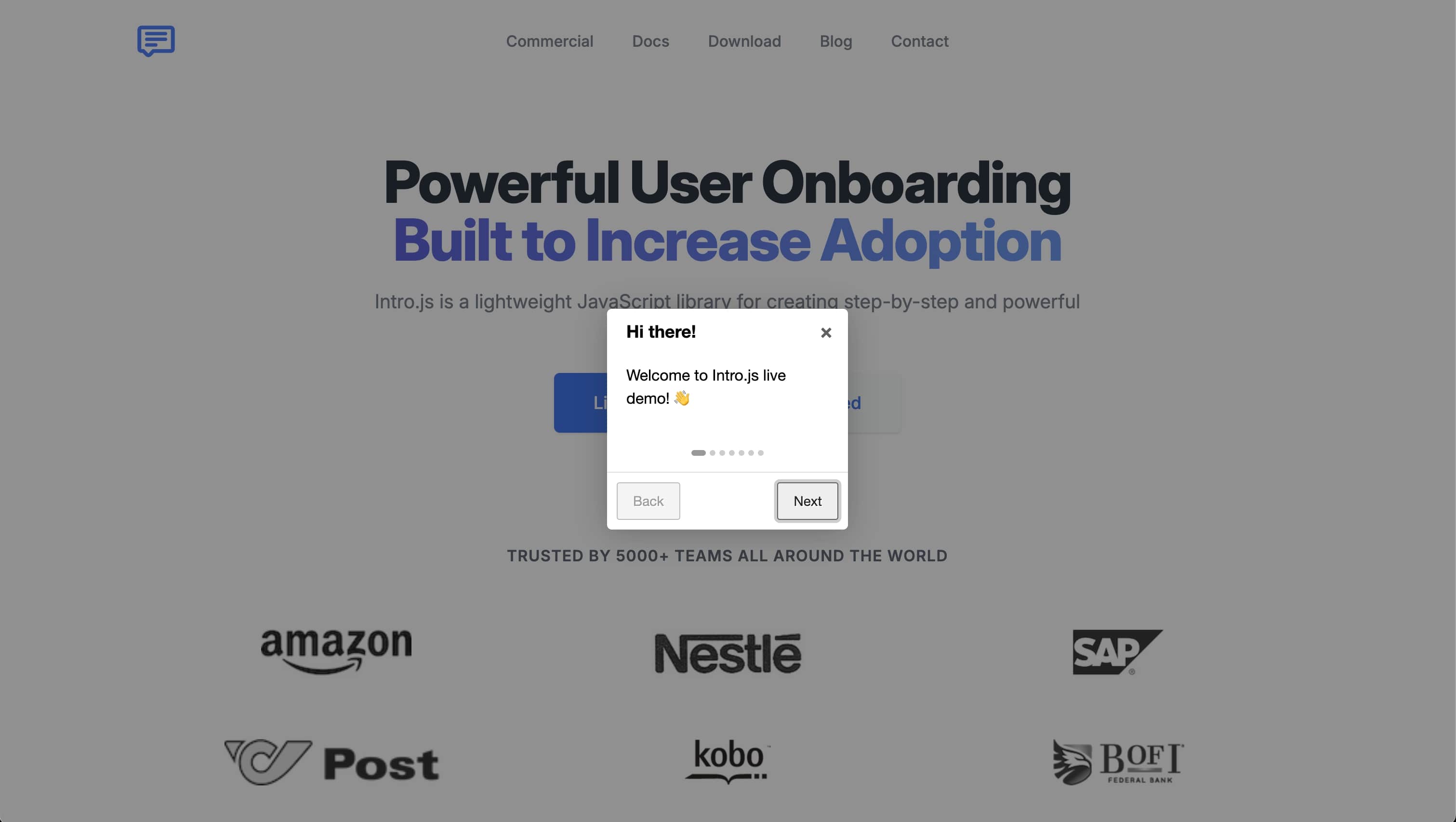
Intro.js remains one of the most recognizable names in this category.
The attraction is obvious: it is mature, easy to understand, and broadly documented. Plenty of teams have used it for years.
The catch is also obvious once legal or procurement gets involved.
Why teams still consider Intro.js
- well-known library with a long history
- familiar step-based tour model
- easy to prototype with
- broad browser support compared with many newer projects
What to watch closely
The license is the main story.
Intro.js uses AGPL v3 for open-source use and offers commercial licensing for businesses that need different terms. That does not make it unusable. It means you should not casually treat it like MIT software and move on.
For some teams, that legal wrinkle is enough reason to choose Shepherd.js or Driver.js instead.
Best for: Teams that like the Intro.js API and are comfortable with the licensing path.
4. React Joyride
React Joyride is often the first serious option React teams try.
That makes sense. It fits the way React apps are already built, and it lets teams keep tour state close to application state instead of layering a generic DOM tool on top.
Why React teams choose it
- React-first developer experience
- easy to wire into component state and app events
- useful for both basic walkthroughs and more guided flows
- large enough ecosystem that examples are easy to find
Where teams run into friction
The first implementation is usually straightforward.
The fifth is where the complexity shows up.
Once tours become role-based, conditional, and tied to app events across multiple routes, React Joyride can turn into something you actively orchestrate rather than something that simply works.
That is not a flaw unique to Joyride. It is the tax of custom onboarding.
Best for: React products that want a familiar component-driven path to in-app tours.
5. Reactour

Reactour is another solid React-specific option, especially for teams that want a product-tour layer that feels closer to React component composition than to an old-school plugin.
Why Reactour stands out
- React-native-feeling API
- accessible overlays and mask behavior
- easier fit for teams already building custom UI systems in React
- useful when design control matters more than plug-and-play simplicity
Tradeoff
Reactour is not trying to be the universal answer for every stack.
That is good if you are deeply invested in React. It is less useful if your product environment is mixed or if you want a framework-agnostic path.
Best for: React teams that care about design control and want onboarding to live inside their component system.
6. Onborda
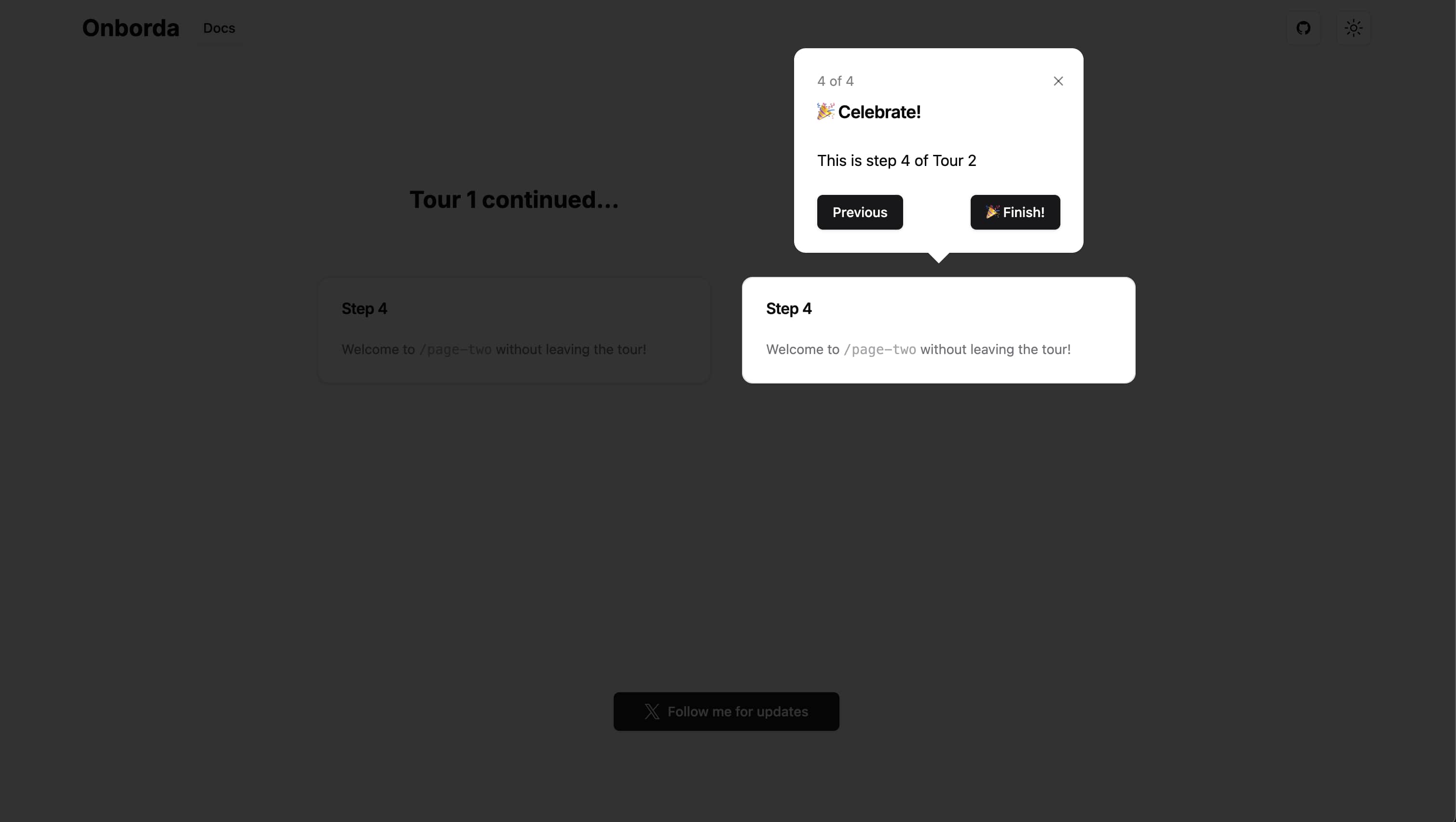
Onborda is interesting because it reflects where a lot of modern SaaS apps live now: Next.js, TypeScript, and animation-heavy frontend stacks.
It is narrower than some of the older libraries, but that is part of the appeal.
Why teams look at Onborda
- built with modern Next.js usage in mind
- supports route-aware onboarding flows
- good fit for teams using Framer Motion and Tailwind-heavy stacks
- better match for current frontend conventions than many legacy tour libraries
Tradeoff
The narrower focus means a smaller ecosystem and less battle-tested history than Shepherd.js or Intro.js.
If you value maturity above all else, you may still prefer an older project. If you want a library that feels aligned with how a modern Next.js app is structured, Onborda is worth serious consideration.
Best for: Next.js product teams that want a modern, stack-aligned tour library.
7. Hopscotch
Hopscotch still gets mentioned because older blog posts refuse to die.
That is not a reason to use it.
The project is archived. It is a historical artifact, not a recommendation.
If you are evaluating libraries in 2026, Hopscotch belongs on the page for one reason only: to prevent someone on your team from choosing it because they found an old tutorial.
Best for: Nobody shipping a new production onboarding flow.
When open-source libraries are the right choice
Open source is usually the right path when:
- you have engineers who can own onboarding code
- your first requirement is tours or highlights, not a full adoption platform
- design-system control matters more than no-code editing
- your user volume or stage does not justify a larger commercial tool yet
- you want to prototype onboarding before standardizing process around it
That is the sensible path for a lot of startups.
You should not feel pressured to buy a giant platform just to ship a tooltip.
When a library stops being enough
This is the part many comparison posts skip.
The library is rarely what breaks first.
The operating model breaks first.
You start with one welcome tour. Then a PM wants onboarding by role. Then customer success wants a checklist. Then growth wants experiments. Then leadership wants adoption metrics. Then support wants announcements tied to releases.
At that point, you are no longer choosing a tooltip library.
You are building or buying an onboarding system.
That is where teams often move from open-source libraries to a broader product adoption platform such as Userorbit, especially when they want tours, checklists, announcements, feedback, and analytics to live in one place instead of inside custom frontend code.
Use the build-vs-buy product tour guide to compare that platform decision against the ongoing maintenance cost of another library.
Which open-source product tour library should you choose?
Choose Shepherd.js if you want
- the most balanced option for robust custom tours
- a mature API with strong production flexibility
- framework-agnostic control
Choose Driver.js if you want
- quick setup
- simple highlights and short walkthroughs
- minimal cognitive overhead for engineers
Choose Intro.js if you want
- a mature library with a familiar tour pattern
- broad usage history
- and you are comfortable with the licensing path
Choose React Joyride or Reactour if you want
- React-first onboarding implementation
- tighter alignment with component state and React app architecture
- less dependence on a generic DOM abstraction layer
Choose Onborda if you want
- a modern Next.js-first option
- route-aware tours in a newer frontend stack
- something that feels aligned with current app architecture
Final verdict
There is no universal winner in open-source product tour libraries.
There is only the library that matches the shape of your product and the stage of your team.
For most teams that want a strong all-around open-source option, Shepherd.js is the safest recommendation. It is flexible, credible, and production-friendly.
For teams that care more about speed and simplicity, Driver.js is often the better choice.
For React-heavy products, React Joyride and Reactour make more sense than pretending framework differences do not matter.
And for teams already feeling the strain of custom onboarding ownership, the better move may be to stop comparing libraries and start comparing platforms like Userorbit.
FAQs about open-source product tour libraries
Are open-source product tour libraries free for commercial use?
Some are. Some are not in the simple way people assume.
MIT and Apache licenses are usually easier for commercial teams to adopt. Intro.js deserves extra attention because AGPL terms can trigger legal review depending on your use case.
What is the best open-source product tour library for React?
React Joyride and Reactour are usually the strongest starting points for React-specific implementations. Shepherd.js can still work in React apps if you want a more framework-agnostic core.
What is the best open-source product tour library for Next.js?
Onborda is one of the most relevant Next.js-specific options, especially for teams already using modern app router patterns and TypeScript-heavy setups.
Should I use an open-source library or buy onboarding software?
Use a library when you mainly need tours and your team can maintain the code. Move to onboarding software when segmentation, analytics, checklists, announcements, experiments, and cross-team ownership start to matter more than raw implementation control.
Is Hopscotch still a good option?
No. It is archived and should be treated as historical context, not an active recommendation.
What should I check before choosing a library?
Check maintenance activity, accessibility behavior, routing support, framework fit, license terms, and how much product logic your team is willing to own over time.