








Survey builders look remarkably similar in a demo. Add a question, choose a theme, publish a widget.
The differences appear later, when you need to ask only account administrators who completed a particular workflow, keep the answer attached to the right company, and send a useful response somewhere your team will actually act on it.
This guide compares seven products that can run surveys inside a SaaS application. Refiner is the strongest focused microsurvey product in the group. Userorbit is a better fit when surveys need to connect with feedback, roadmap decisions, onboarding, and announcements. Survicate covers the widest range of survey channels, while Sprig is built for a more formal research operation.
The seven tools at a glance
| Tool | Best fit | Starting point | The tradeoff |
|---|---|---|---|
| Refiner | SaaS teams that want a dedicated in-product survey tool | Free for 25 responses/month; paid plans scale by MAU | Advanced event and data integrations require Growth |
| Userorbit | Lean B2B SaaS teams connecting surveys to product workflows | $95/month billed annually | Less research-program depth than Sprig |
| Survicate | Teams running surveys across product, mobile, email, and web | Free; Growth from $114/month billed annually | Response and data-point limits both affect cost |
| Sprig | Enterprise product-research organizations | Custom quote | More platform and procurement than most small teams need |
| Formbricks | Open-source and privacy-conscious teams | Free for 250 responses/month; Pro from $74/month | Identification and segmentation require Pro |
| Userpilot | Growth teams that already need product analytics and engagement | $299/month for NPS; advanced surveys from $849/month | Expensive if surveys are the main requirement |
| Pendo | Organizations already running Pendo analytics and guides | Free to 500 MAUs; paid plans custom priced | Full Sentiment access is modular |
How we chose these tools
We looked for products that can show a survey inside a logged-in web or mobile experience and decide who sees it using more than a page URL. The comparison emphasizes behavioral targeting, question logic, respondent context, analysis, integrations, mobile coverage, and the cost of running an ongoing program.
Userorbit publishes this guide, and we have deeper first-hand access to Userorbit than to the other products. Competitor details come from their current product, documentation, and pricing pages. That perspective is disclosed because it matters: the list should still recommend a specialist when the specialist is the better fit.
In-app surveys are not just embedded forms
A generic form knows that someone answered. A good in-app survey can know that a new administrator finished setup, a user abandoned an import, or an account adopted a feature for the first time. That context lets you ask less and learn more.
The category is also narrower than customer feedback software. Survey tools ask a defined audience a structured question at a chosen moment. Feedback platforms collect and organize a wider stream of requests, interviews, support evidence, votes, and visual reports. Some products cover both jobs, but buyers should not treat them as interchangeable.
Before shortlisting a tool, decide which event should trigger the survey, which user or account traits matter, where the answer needs to go, and what action a response could change. If no answer changes the next step, the survey is an interruption rather than research.
1. Refiner: best dedicated microsurvey tool for SaaS
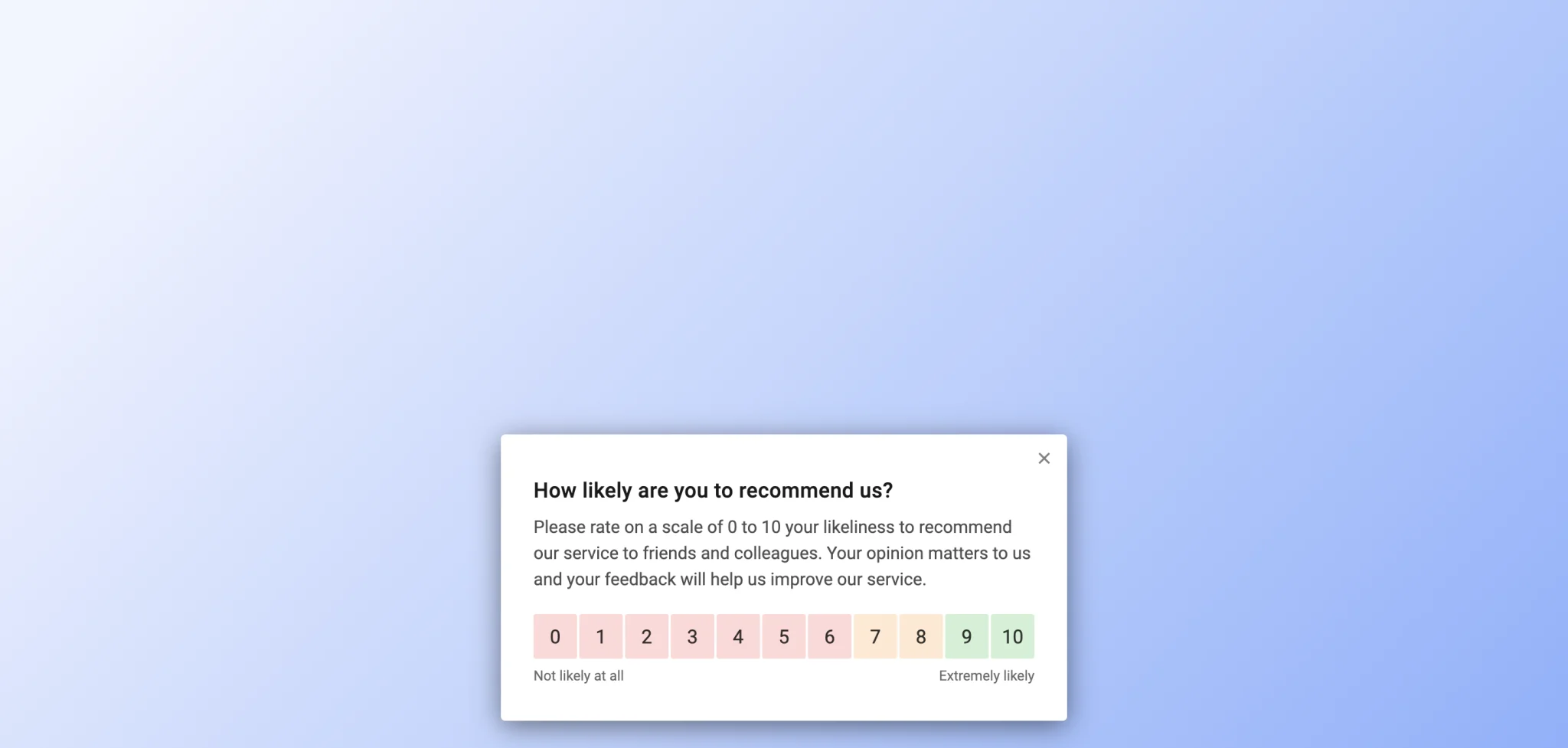
Image source: Refiner's in-app survey documentation.
What this does
Refiner runs contextual surveys inside logged-in web and mobile products. It supports NPS, CSAT, CES, PMF, and custom studies, with branching, design controls, respondent segmentation, and AI tagging for open-text answers.
Strengths
- Surveys can trigger from events, feature use, lifecycle stage, pages, and user traits.
- Integrations cover Segment, Amplitude, Mixpanel, HubSpot, Salesforce, Slack, and Teams.
- The free plan includes 25 responses per month; paid plans include unlimited responses and scale by MAUs.
- Its SaaS-specific focus makes it easier to treat surveys as part of the product-data stack rather than as an isolated form widget.
Event tracking, AI translation, and the deeper CDP, CRM, and analytics integrations require Growth. Refiner's public configurator does not expose one universal paid price.
Best for
SaaS, fintech, and marketplace teams that want a dedicated microsurvey product and already have the rest of their analytics, CRM, and product workflow in place.
Not best for
Teams looking for a broader feedback, roadmap, onboarding, or announcement platform. Refiner is strongest when in-product surveys are the primary job.
2. Userorbit: best when surveys need to drive product work
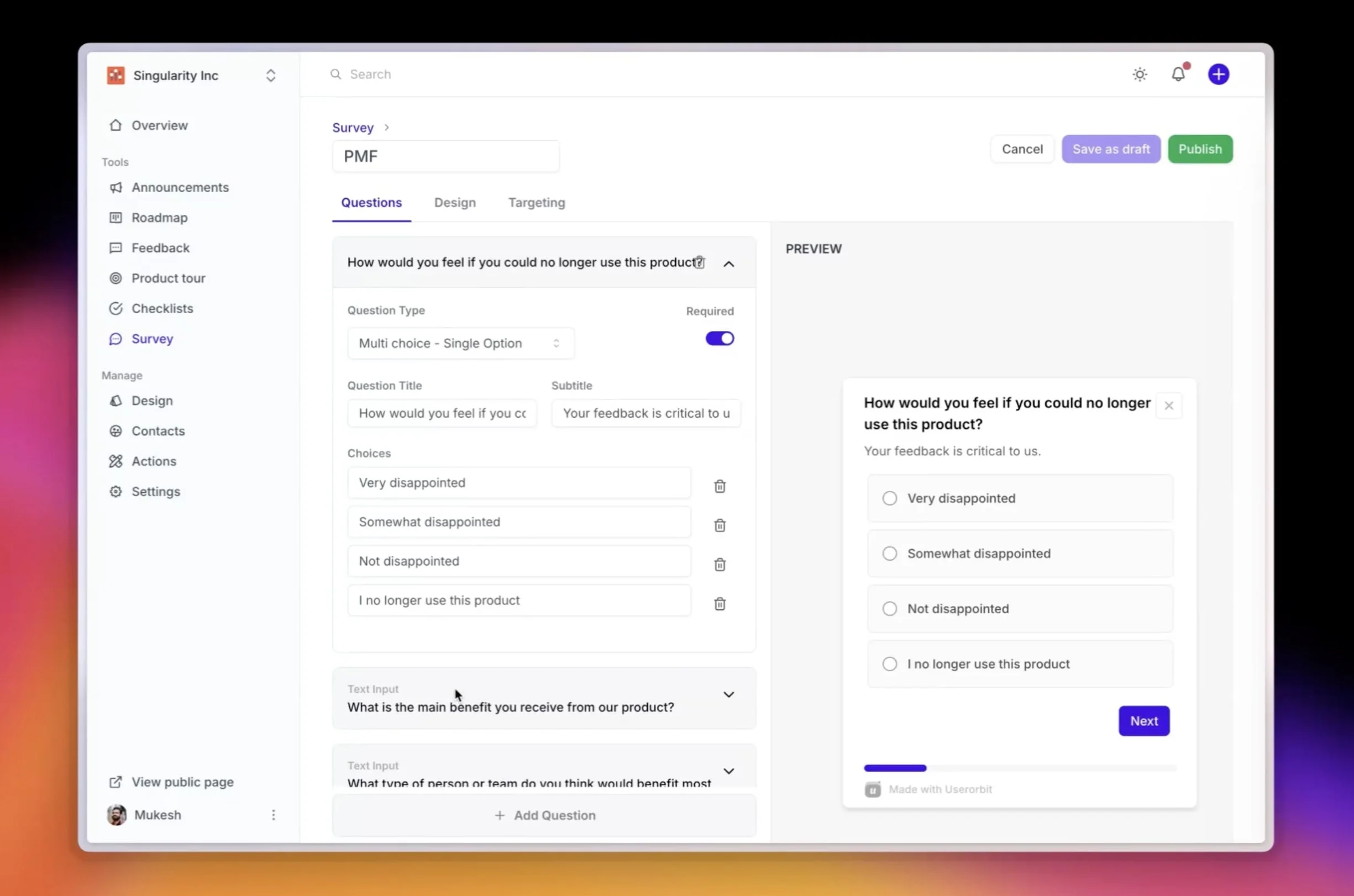
Image source: Userorbit Surveys.
What this does
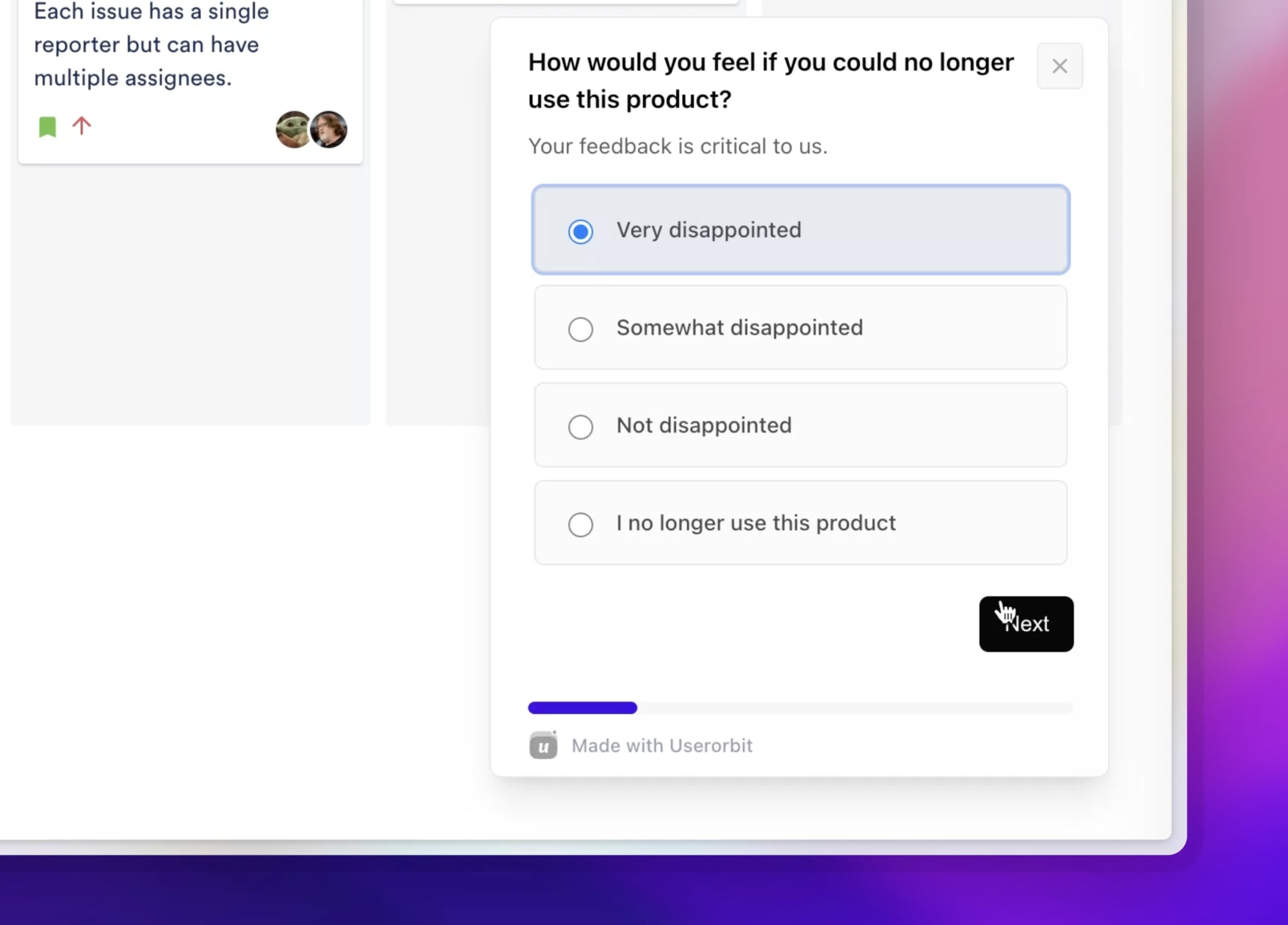
Userorbit Surveys runs NPS, CSAT, CES, and custom surveys inside a SaaS product. Responses stay connected to the customer so teams can carry evidence into feedback and roadmap work, communicate what changed, and then watch what users do next.
Strengths
- Targeting can use product behavior, segments, account or user attributes, and events.
- Survey responses live alongside feedback boards, roadmap decisions, announcements, onboarding, and product analytics.
- Growth costs $95 per month billed annually for 5,000 MAUs and includes unlimited surveys.
- The connected workflow reduces the handoffs between collecting an answer and acting on it.
Best for
Lean B2B SaaS teams that want surveys to feed product decisions and customer communication without stitching together several specialist tools.
Not best for
Dedicated research organizations that need participant panels, formal study governance, or a deep research repository. Sprig has more depth for that operating model.
3. Survicate: best multichannel survey platform
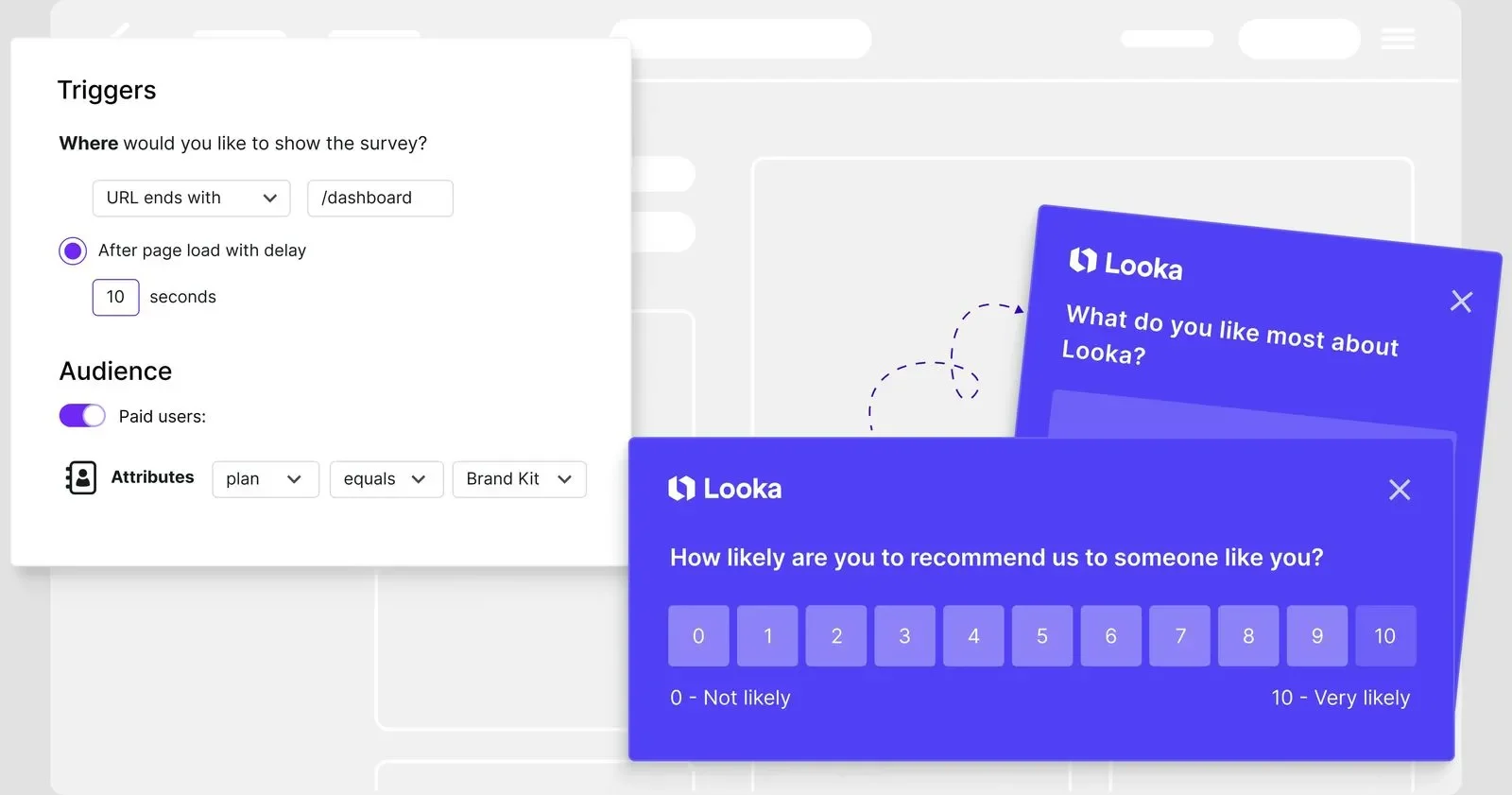
Image source: Survicate's in-product survey product page.
What this does
Survicate delivers surveys in-product, through native mobile SDKs, by email or link, as website popups, and inside an iframe. The same workspace can therefore support product research and broader customer-experience listening.
Strengths
- Event and attribute targeting support contextual in-product studies.
- The builder covers recurring surveys, NPS, CSAT, CES, multiple question types, logic, and custom branding.
- Dashboards, exports, and a large integration catalog help consolidate several feedback channels.
- There is a free entry point; the displayed Growth configuration starts at $114 per month billed annually for 250 monthly responses and 1,000 data points.
Best for
Product or CX teams that own surveys across product, mobile, email, and web and do not want a separate survey product for each channel.
Not best for
Teams that only need a focused SaaS microsurvey tool. Advanced targeting, logic, integrations, branding, response allowances, and data-point limits vary by plan, so Survicate also requires careful cost modeling.
4. Sprig: best for an enterprise research program
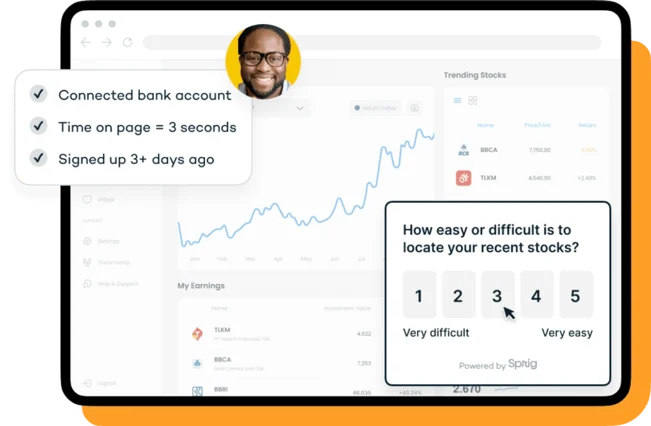
Image source: Sprig's guide to groups and in-product surveys.
What this does
Sprig treats in-product surveys as part of a broader research system. Studies can run inside web and mobile products, through email, or with recruited panels, using behavioral events and user attributes to trigger research in context.
Strengths
- Survey answers can be paired with session replay clips from before and after the response.
- AI-assisted study design, fielding, and synthesis support a formal research workflow.
- Governance and access controls are designed for research spread across multiple teams and products.
- Pricing is quote-based and scales with response volume, enabled research capabilities, and deployment environments.
Best for
Enterprise research organizations that need to understand both what a participant said and what they were doing, with governance around studies and insights.
Not best for
Small SaaS teams that mainly need a few targeted microsurveys. Sprig brings more platform, process, and procurement than that use case usually requires.
5. Formbricks: best open-source option
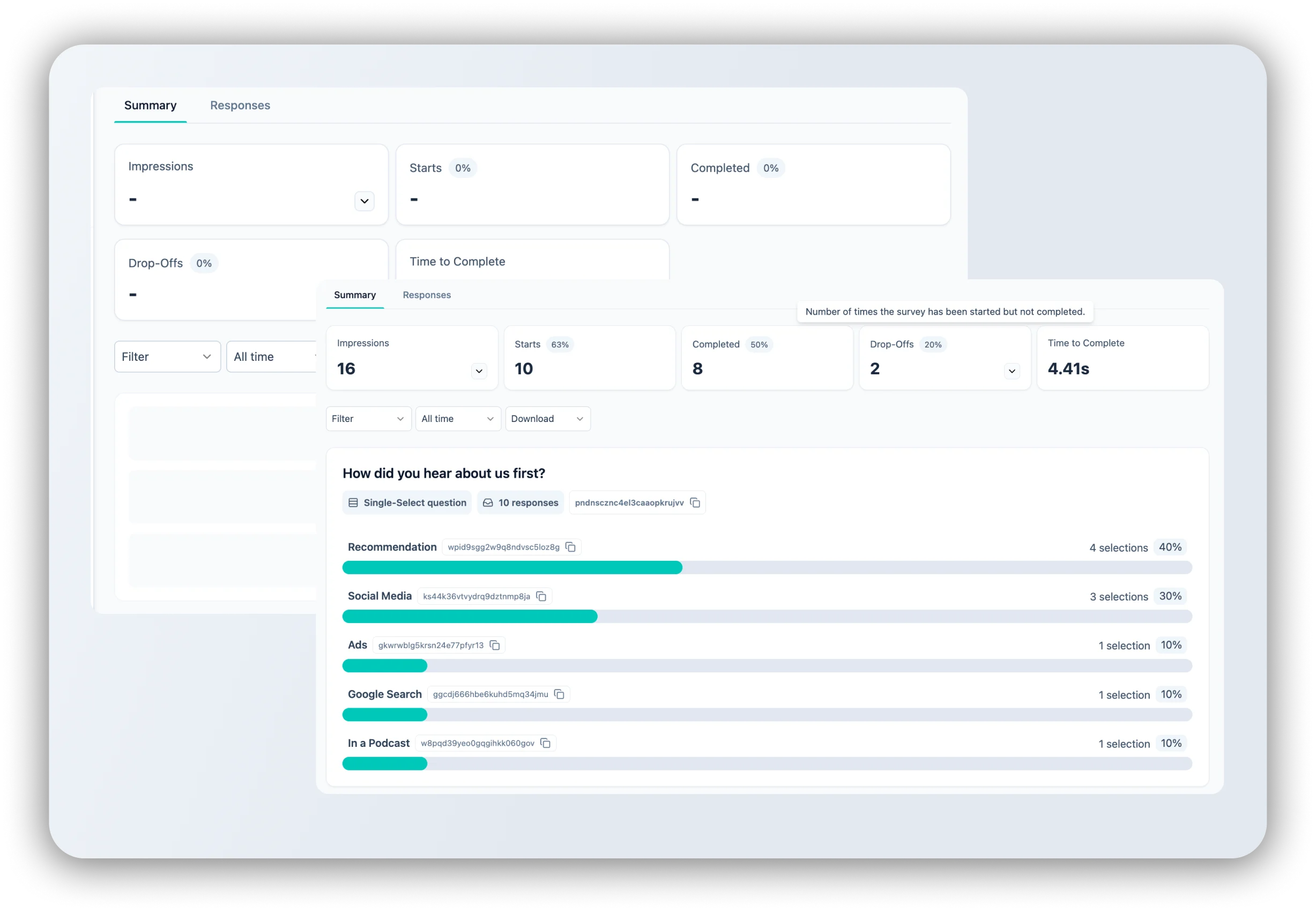
Image source: Formbricks 5.1 product update.
What this does
Formbricks provides link and in-product surveys as both a managed cloud service and a self-hosted open-source product.
Strengths
- The free Hobby tier includes conditional logic, partial responses, API access, and 250 responses per month.
- Pro starts at $74 per month on the annual pricing view.
- Pro adds identified respondents, contact and segment management, integrations, custom webhooks, and iOS and Android SDKs.
- Source access and self-hosting give teams more control over deployment and where survey data lives.
Best for
Privacy-conscious or engineering-led teams that require source access, self-hosting, or tighter control over survey infrastructure and data residency.
Not best for
Teams that do not want to own upgrades, security, reliability, and support. The free tier is also limited for serious SaaS research because identified respondents and segmentation require Pro.
6. Userpilot: best for analytics-led growth teams
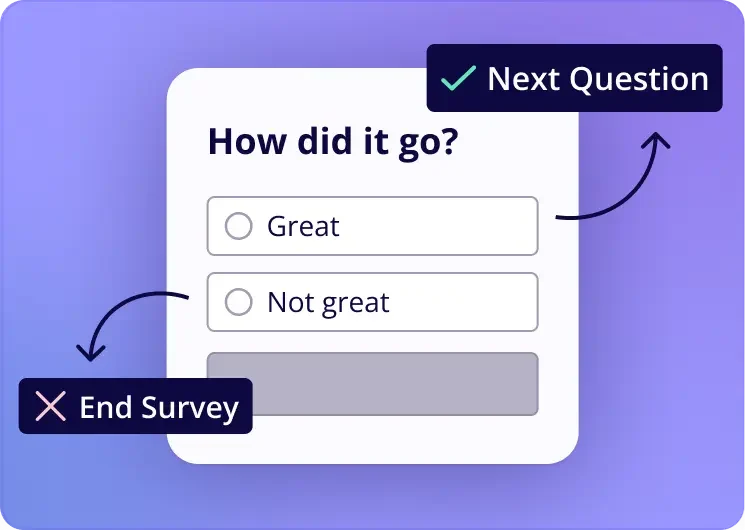
Image source: Userpilot's user feedback product page.
What this does
Userpilot combines in-app engagement, product analytics, session replay, and feedback. Its survey tools support NPS, CSAT, CES, custom questions, branching, AI summaries, and CRM synchronization.
Strengths
- Surveys can trigger from clicks, page visits, feature use, and other product behavior.
- Results can be analyzed using user and account attributes alongside product analytics.
- Engagement and survey tools share one targeting and measurement layer.
- Starter costs $299 per month for 2,000 MAUs and includes NPS.
Advanced in-app surveys begin on Growth at $849 per month, so buyers evaluating custom research should use the Growth price rather than Starter in their comparison.
Best for
Growth teams that already need Userpilot's analytics and in-app engagement platform and want surveys to use the same behavioral data.
Not best for
Survey-only buyers. The platform premium is hard to justify against Refiner, Survicate, or Formbricks when analytics and engagement are not part of the requirement.
7. Pendo: best for existing Pendo customers
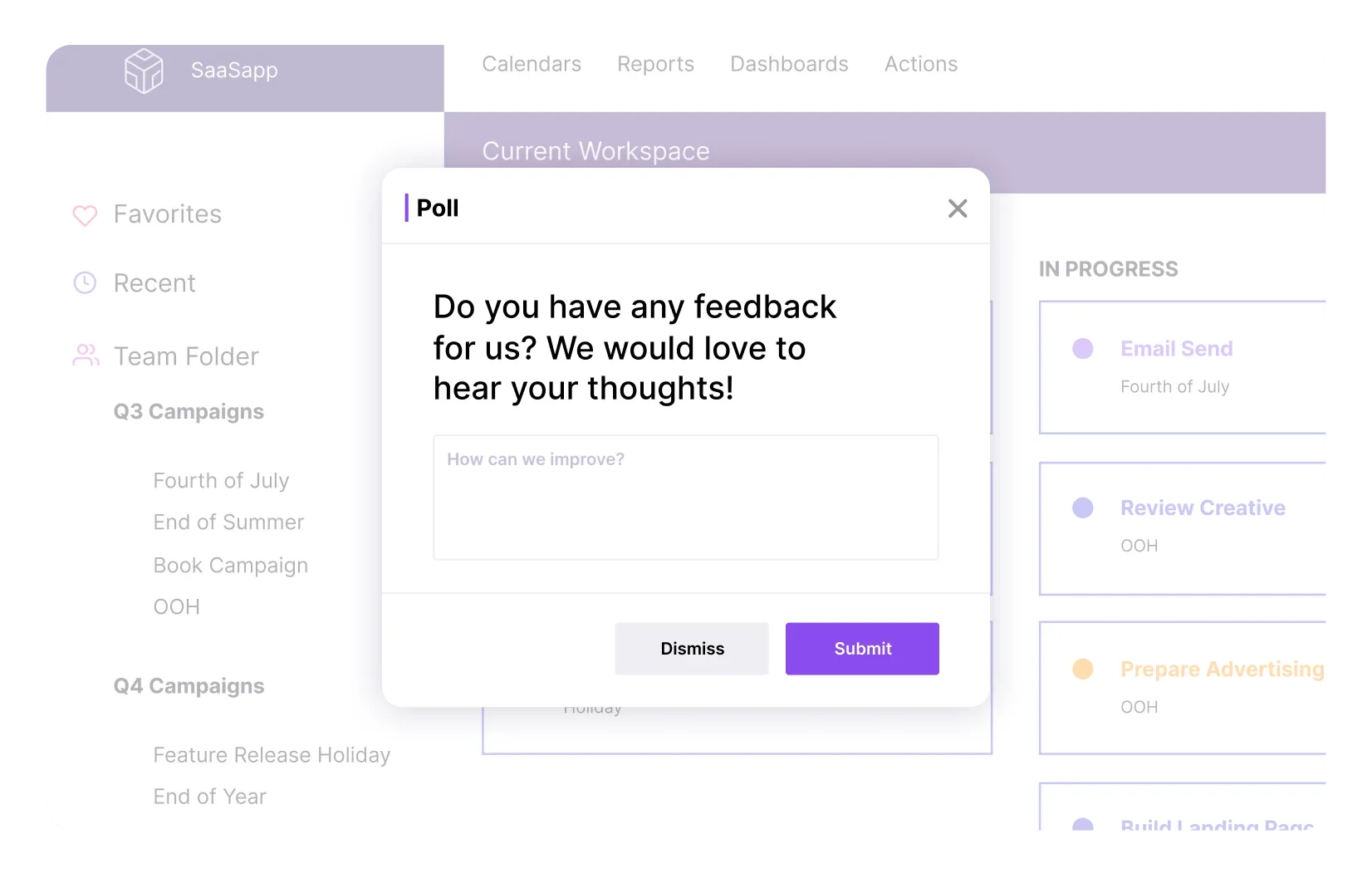
Image source: Pendo's surveys and polls product page.
What this does
Pendo's surveys and polls use the same segments and behavioral context as its product analytics and in-app guides. Surveys can therefore target users based on product behavior and combine qualitative feedback with usage data.
Strengths
- Survey targeting, analytics, and in-app guidance live inside one established platform.
- The same capability can support customer-facing and employee software.
- Pendo Free supports up to 500 MAUs and includes Pendo-branded NPS.
- Paid Base, Core, and Ultimate plans use custom pricing; full Sentiment, including NPS, PMF, and CSAT, is included with Ultimate and available as an add-on elsewhere.
Best for
Organizations already using Pendo analytics and guides that want to add contextual surveys without introducing another SDK or data model.
Not best for
Small teams buying primarily for surveys. Pendo's modular packaging can leave them paying for much more platform than they need to ask contextual questions.
How to narrow the shortlist
Use the first decision below that clearly describes your situation:
- You want the strongest dedicated SaaS microsurvey product: start with Refiner.
- Responses need to connect with feedback, roadmap, communication, and onboarding: compare Userorbit with Refiner.
- You own surveys across product, email, mobile, and web: start with Survicate.
- A formal research organization needs governance and behavioral evidence: shortlist Sprig.
- Self-hosting or source access is mandatory: use Formbricks.
- Your organization already runs Userpilot or Pendo: test the survey module before adding another SDK.
Then configure one real study during the trial. Trigger it from a meaningful event, restrict it to an eligible account segment, submit a response, and follow that response into the system where someone must act on it. A polished widget proves very little if the answer loses its context after submission.
Sources and update notes
This comparison focuses on surveys delivered inside a logged-in SaaS product. Generic form builders and feedback-board products were excluded because they solve different primary jobs. Product capabilities and prices were checked against official vendor pages on August 19, 2026. We did not run the same controlled response-rate experiment across all seven products.
Frequently asked questions about in-app survey software
Practical answers for SaaS teams choosing and implementing an in-product survey platform.