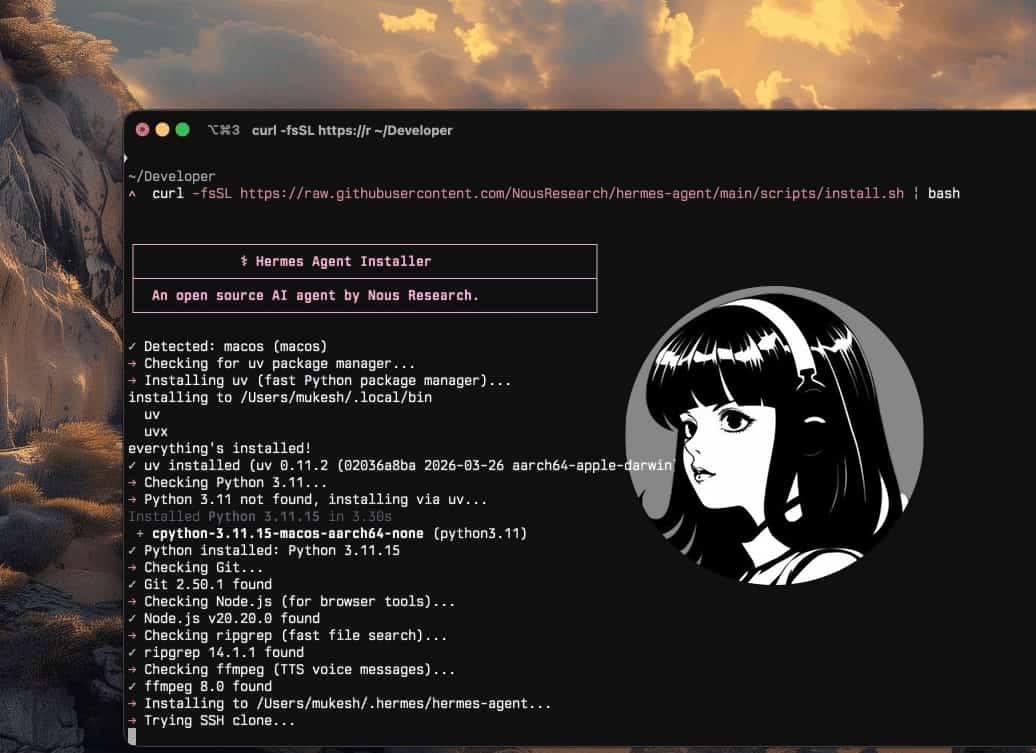

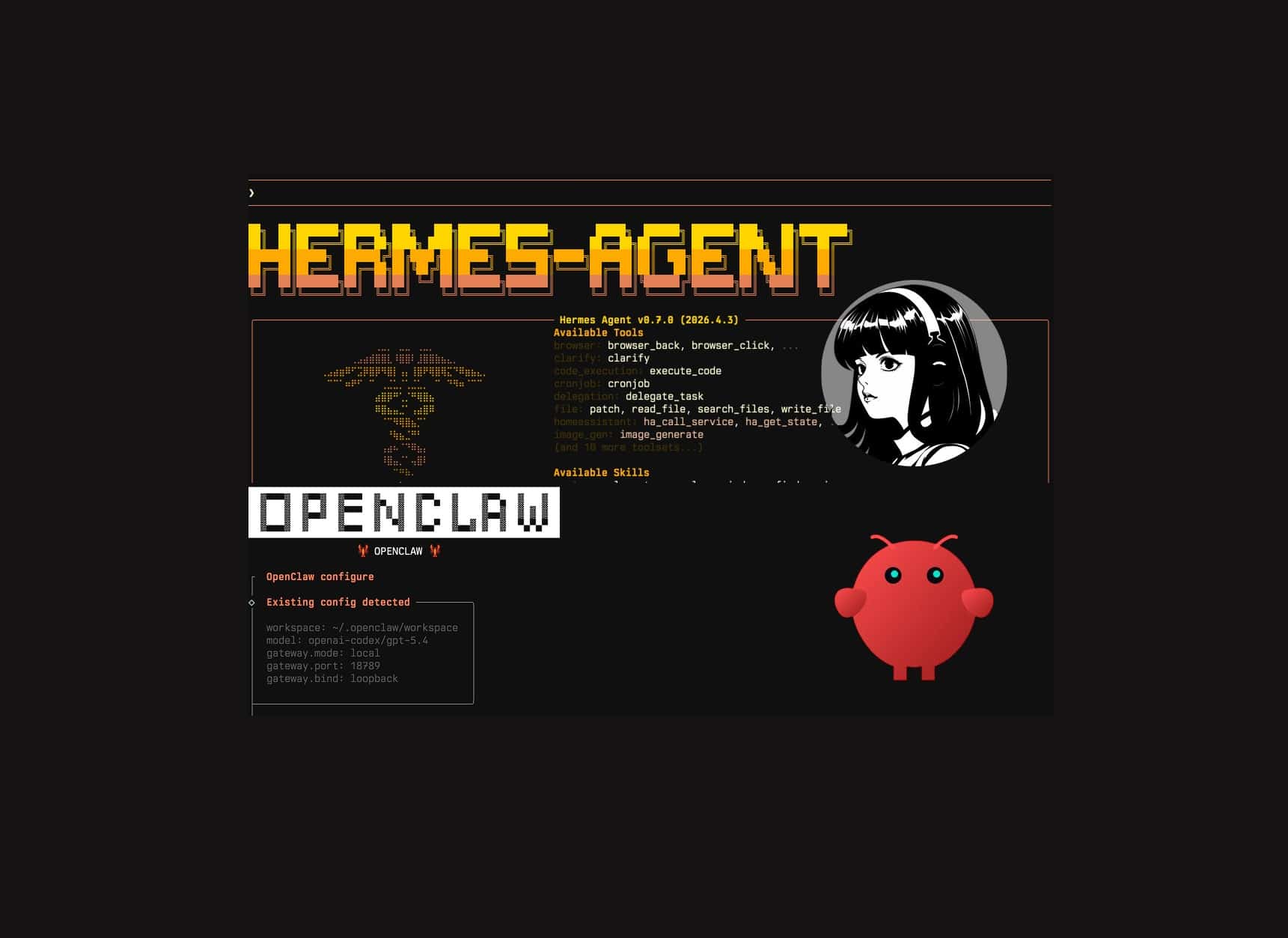








Hermes Agent and OpenClaw are both open-source AI agent runtimes, but they solve different problems. Hermes is a single self-improving agent. OpenClaw is a multi-agent gateway. Picking the right one depends on whether you need one very capable assistant or a platform for orchestrating many agents across many channels.
Architecture
Hermes puts the agent loop at the center of its architecture. The core is a synchronous "do, learn, improve" cycle — with the gateway, cron scheduler, tooling runtime, ACP integration, and SQLite-backed session persistence all structured around that loop. It's Python-native with a direct agent loop you can inspect and modify at every step. It can spawn isolated subagents for parallel tasks, and you can interact with it via CLI, a built-in TUI (with multiline editing, autocomplete, task interruption, and streaming tool output), or through messaging apps like Telegram, Discord, Slack, WhatsApp, and Signal.
OpenClaw is organized around a control-plane-first gateway — a single long-running process that owns sessions, routing, tool execution, and state. Everything flows through it. It's TypeScript-based and designed to orchestrate multiple agents across multiple channels with access controls across teams.
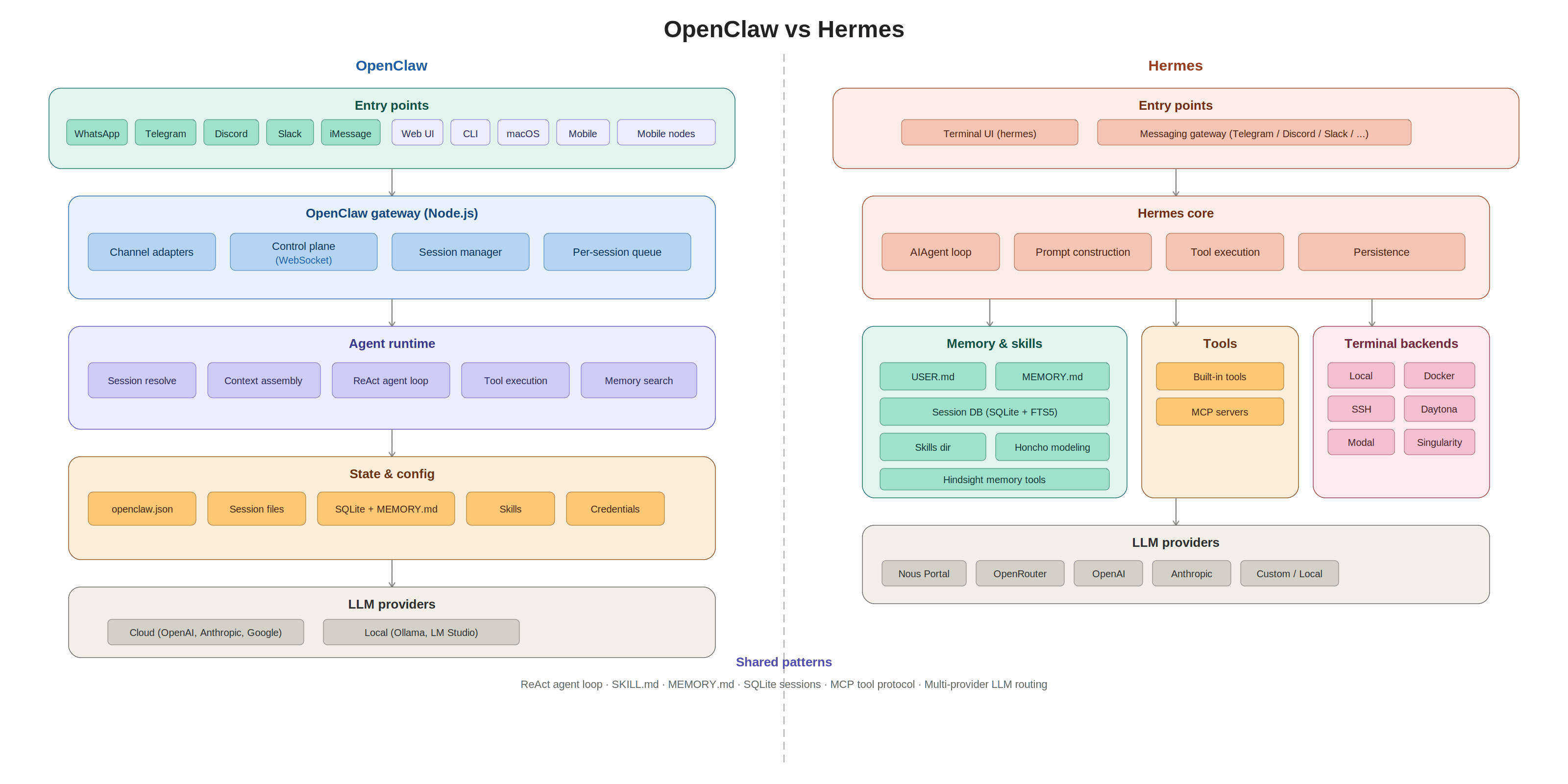
The practical difference: Hermes centers on the agent's own execution loop and builds the system around it. OpenClaw centers on a controller that coordinates everything. Hermes gives you depth on a single agent. OpenClaw gives you breadth across many agents and channels.
Privacy and data locality
Hermes runs with zero telemetry by default. Nothing phones home unless you explicitly configure it. It runs in sandboxed and containerized environments on your own infrastructure — local machines, Docker, SSH, or serverless backends like Modal and Daytona.
OpenClaw is also self-hostable, but its gateway architecture is designed for multi-user deployments where data flows through a central routing layer. If your primary concern is that no data leaves your machine, Hermes's single-agent model is simpler to reason about.
Learning and memory
Hermes treats memory as a layered system: persistent notes, searchable session history stored in SQLite, and procedural knowledge — where the agent converts successful workflows into reusable skills automatically. It recalls past work using full-text search plus LLM summarization. The more you use it, the better it gets at your specific workflows because it remembers methods, not just facts.
OpenClaw takes a different approach. Its memory system is file-backed and explicit — identity lives in a SOUL.md file, and skills are mostly human-authored, loaded from workspace, personal, shared, or plugin scopes. This gives you tighter manual control over what the agent knows and does, at the cost of the agent not learning new procedures on its own.
The tradeoff is real: Hermes's self-improving loop means less manual configuration over time, but you're trusting the agent to learn the right behaviors. OpenClaw's explicit approach means more upfront work, but you always know exactly what the agent will do. For product teams running the same workflows repeatedly — feedback triage, roadmap reviews, changelog drafting — Hermes's procedural memory is a clear advantage. For teams that need predictable, auditable agent behavior, OpenClaw's manual skill authoring may be preferable.
Model support
Hermes connects to Nous Portal, OpenRouter, or any OpenAI-compatible endpoint, giving access to 200+ models including local deployments via Ollama and vLLM. It pairs naturally with Nous's own Hermes 3 and Hermes 4 models — open-weight Llama-based models with hybrid reasoning modes and strong math/logic performance.
OpenClaw also supports multiple model providers, with a focus on routing different models to different agents based on task complexity and cost.
Both give you model flexibility. Hermes treats model selection as configuration — you switch models with the hermes model command rather than changing application code. Hermes has a tighter integration story with the Hermes model family, while OpenClaw's routing approach is better suited for cost optimization across many agents.
Tools and skills
Hermes ships with 40+ built-in tools (web search, browser automation, filesystem, vision, image generation, code execution, subagent delegation, cron scheduling) and an open-standard skills system for extending capabilities. Skills follow a SKILL.md format and can be shared across agents and environments. Crucially, Hermes also generates skills automatically — when a workflow succeeds, the agent can package it as a reusable procedure without you writing anything.
OpenClaw has a plugin marketplace with a broader ecosystem of pre-built integrations, particularly for messaging channels and enterprise tools. Its skills are human-authored and loaded from multiple scopes (workspace, personal, shared, plugins), giving you explicit control over what the agent can do. Its plugin architecture is designed for multi-channel deployments where different agents need different capabilities.
If you want an agent that builds up its own skill library over time, Hermes's procedural learning is unique. If you want a curated, predictable set of capabilities deployed across many agents with governance controls, OpenClaw's marketplace and manual authoring model is better suited.
Automation and scheduling
Hermes includes natural-language cron scheduling — describe when you want something to run and the agent handles the rest. Combined with subagent delegation, this lets you set up complex recurring workflows like "every Monday at 9am, run three parallel analyses and compile a briefing."
OpenClaw handles scheduling through its gateway layer, which is more suitable for orchestrating scheduled tasks across multiple agents and channels.
When to choose Hermes
- You want a single, capable agent that improves over time from your usage
- Privacy and data locality are non-negotiable — zero telemetry, runs entirely on your infrastructure
- Your workflows are research, coding, product management, or ad-hoc automation for one team
- You prefer Python and want to inspect/tweak the agent loop directly
- You want tight integration with Hermes 3/4 open-weight models
- You value fast time-to-value over architectural flexibility — a fresh Hermes install is productive immediately
When to choose OpenClaw
- You're building a multi-user, multi-channel system routing messages across WhatsApp, Slack, Telegram, and more
- You need enterprise-style access controls and governance across teams
- You want a plugin marketplace with many pre-built integrations
- Your architecture requires multiple specialized agents coordinated through a central gateway
- You're building on TypeScript and want to extend the gateway layer directly
Using either with Userorbit
Both Hermes and OpenClaw can manage product workflows through the Userorbit skill. Userorbit centralizes analytics, feedback, roadmaps, announcements, and help docs behind a single API — the kind of tool both agent runtimes are designed to integrate with.
For Hermes, the skill installs directly into the skills system:
hermes skills search userorbit/skill/userorbit
hermes skills install userorbit/skill/userorbit
For OpenClaw, add the skill's SKILL.md and API reference to your agent's context configuration.
Either way, you get natural language access to 60+ Userorbit API endpoints for feedback, announcements, roadmaps, and help center operations. For a full walkthrough with Hermes, see Getting Started with Hermes Agent.
Userorbit
Works with any agent runtime
Userorbit's skill and API work with Hermes, OpenClaw, Claude Code, Codex, Cursor, and Copilot. Automate product management from whichever agent you choose.
- 60+ API endpoints for feedback, announcements, roadmaps, and docs
- Single skill file works across agent runtimes
- AI-drafted changelogs, tours, and articles from every deploy
- Install and connect in minutes
The short version
Hermes is the right choice if you want one agent that gets better at your workflows over time, runs privately on your infrastructure, and is productive out of the box. OpenClaw is the right choice if you need predictable, auditable agent behavior across many channels with enterprise governance and tighter manual control. They solve different problems well — the choice comes down to whether you value self-improvement or explicit control.